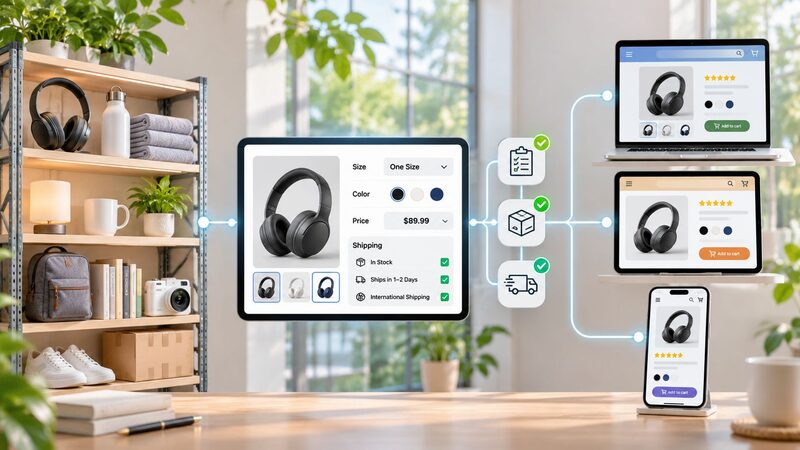
24.2% of 1,000 small and medium-sized businesses surveyed for a 2016 Local Commerce Monitor study said they ran a customer loyalty program, which means nearly three in four didn't (SumUp's loyalty data story). Interest was rarely the obstacle. Among the businesses that did run one, only about a third used an in-house digital tracking system, so most were managing rewards on paper, in a spreadsheet, or from memory.
That gap between wanting repeat customers and being able to run rewards profitably is where small-business loyalty money leaks away. I'd start you in an unusual place: not with a model, not with a tool, but with two numbers you can write down this afternoon. What an unredeemed reward costs if every customer eventually cashes in, and how much extra repeat business the program has to create to cover that cost. Get those wrong and the prettiest stamp card in town is just a slow-motion discount.
Table of Contents
- Loyalty Program Models Compared at a Glance
- Matching Rewards to Purchase Frequency and Measuring the Lift
- Working Out Reward Liability and Margin Before Launch
- How to Set Up a Program in Seven Steps
- Rewarding Loyal Customers Without Crossing the Privacy Line
- Choose Your First Loyalty Program Model
Loyalty Program Models Compared at a Glance
A loyalty program for small business is a written deal: what the customer gets for coming back, what it takes to earn, and how long the credit lasts. Every version worth running is one of five models, and the differences that matter are how the customer earns and how much setup the model demands.
| Model | How customers earn | Typical reward | Setup effort | Best fit |
|---|---|---|---|---|
| Stamp card | One stamp per qualifying visit or purchase | Free item after a set number of stamps | Low | Cafés, salons and other frequent-visit businesses |
| Points | Points per dollar or pound spent | Discount or product at set point levels | Medium | Retail stores with varied basket sizes |
| Tiered | Spend or visits move customers up levels | Better perks at each tier | High | Stores where a small group drives most revenue |
| Paid membership | Monthly or annual fee | Member pricing and free shipping | Medium | Predictable, frequent buyers |
| Store credit | Share of each purchase returned as credit | Credit applied to the next order | Low | Higher-margin retail with occasional purchases |
Read the table by column, not by row. Setup effort is the honest cost of administration: a stamp card is a rule your staff can apply at the counter, while a tiered program is a permanent reporting job because you have to know who sits in each tier every week. Best fit follows purchase rhythm. Stamp cards reward frequency, so they suit businesses where a visit is the purchase. Points smooth out basket variation, which is why they dominate retail.
The commercial case for picking a row at all comes from a 2014 survey of nearly 1,000 small-business owners summarised in Retention Edge's loyalty statistics roundup. 61% said more than half of their annual revenue came from repeat customers, and a repeat customer spent 67% more than a new one. Only 34% had a loyalty program, and only 46% of those programs were digitally managed. The research drew on Manta small-business members across samples of 589 and 313 respondents, with margins of error near ±4% and ±5.5%.
Note what that says: repeat buying was already carrying the majority of revenue, and most owners were still tracking it on paper or not at all. The program formalises money that's already arriving.
Occasional-purchase retailers often end up with a hybrid of store credit and tiers, because the reward has to survive a long gap between orders. A golf apparel rewards program is a decent reference point for how a niche retailer handles that gap without discounting every order.
If you run a single location where most customers buy every week or two, start on the stamp card row. If your average basket swings from $12 to $90, start on points.
Matching Rewards to Purchase Frequency and Measuring the Lift
A reward is a return ticket. It earns its keep when the next visit feels half-paid-for already, and that only happens if the card fills inside the customer's natural repurchase window.
A study of loyalty-card use tracked the relationship between shopping frequency and reported loyalty (published in PMC). Against the study's reference category, the estimated odds of loyalty were 1.584 times higher for daily shoppers (p<0.001), 1.455 times higher for weekly shoppers (p<0.001), and 1.234 times higher for monthly shoppers (p=0.021). Frequency does a lot of the work on its own, which is exactly why the reward has to be built around it rather than around your margin spreadsheet.
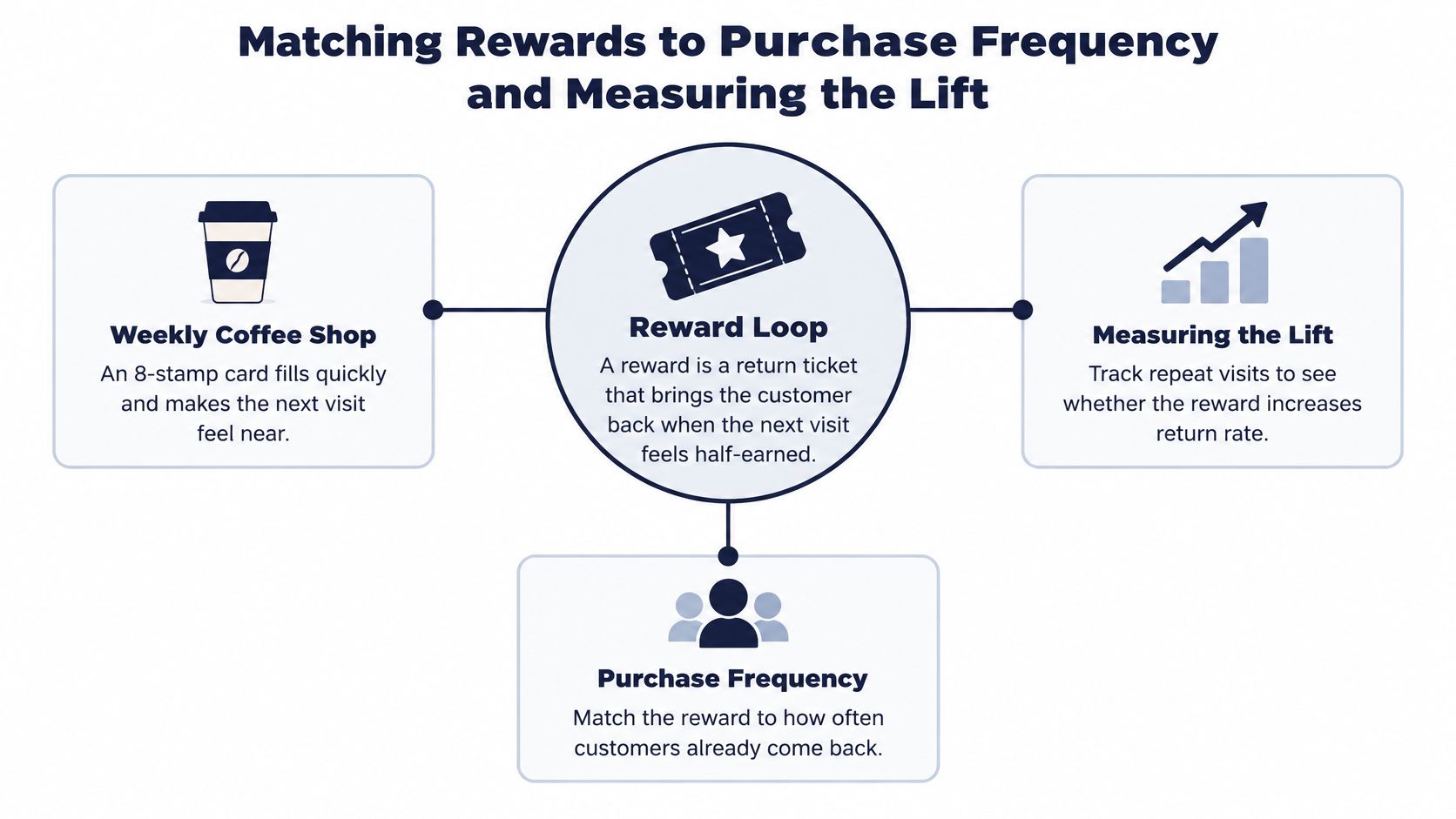
Design rule: count the median days between purchases before you set a threshold. A weekly coffee shop fills an 8-stamp card in about two months. A furniture buyer who returns every two years needs a 12-month store credit plus an anniversary note, not a punch card.
A small-merchant benchmark that tracked issued stamp and points cards shows where activation and habit separate (Reviocard loyalty benchmark):
| Metric | Stamp card | Points card | What it shows |
|---|---|---|---|
| Scanned at least once | 78.9% | 68.5% | Activation: members who started using the card |
| Reached three or more visits | 20.5% | 11.4% | Depth: members who formed a habit |
| Redeemed at least one reward | 4.9% of all issued cards | 4.9% of all issued cards | Redemption: activation alone isn't enough |
| 30-day return rate | 34.2% overall | 34.2% overall | Cohort metric for repeat purchase, not a universal target |
The lesson sits in that third row. Roughly four in five stamp-card holders touched the card, and one in five got three visits deep, yet fewer than one in twenty issued cards ever paid out a reward. Handing out cards is marketing. Redemption is the part that changes behaviour.
If you're running points rather than stamps, this walkthrough of how to reward repeat visits with points covers the mechanics worth copying.
Then there's the trap. Members who join your program are already your better customers, so their spending will look strong whether or not the reward caused it. Attribute nothing until you've compared them with a matched non-member group or with your own pre-program baseline for the same months. Track repurchase rate, purchase interval, average order value and gross margin after reward cost, not total sales. A cohort analysis by enrollment month is the cleanest frame for it.
The test I'd run first: pull your median days between purchases, set the first reward inside that window, and compare repeat rate against the same months last year. If the reward requires more visits than your customers naturally make, momentum stalls and the card becomes clutter in a wallet.
Working Out Reward Liability and Margin Before Launch
Reward liability is the number almost nobody calculates and almost everybody owes. Take every outstanding stamp or point, multiply by what it costs you to honour, and you have your exposure.
Say a bakery has 400 open stamp cards, each one stamp away from a free drink that costs $2.40 in ingredients and packaging. That's up to $960 of exposure sitting in customers' wallets, and it lands the week a promotion pushes 200 of them over the line.
Now test the reward against margin instead of against revenue. A $5 reward on a $60 basket is an 8.3% give-up. If that basket carries a 40% gross margin, you've booked $24 of gross profit and handed back a fifth of it. On a $25 basket, the same $5 reward takes a third. That's why minimum spend and exclusions for already-discounted lines exist.
Set the cap before you launch, not after. A fixed monthly liability ceiling, reviewed at 90 days, is the difference between a controlled cost and a surprise on your profit and loss.
Break-even is a plain question. The program pays only if the extra repeat purchases it creates cover the reward cost plus the hours you spend running it. Nobody can tell you that number in advance, but you can bound it: if the program needs an extra 30 orders a month at your average margin, you'll know within a quarter whether it's plausible.
Write the goal, the reward threshold and the liability limit on one page. That page is your brief for every later decision, including which tool you buy.
How to Set Up a Program in Seven Steps
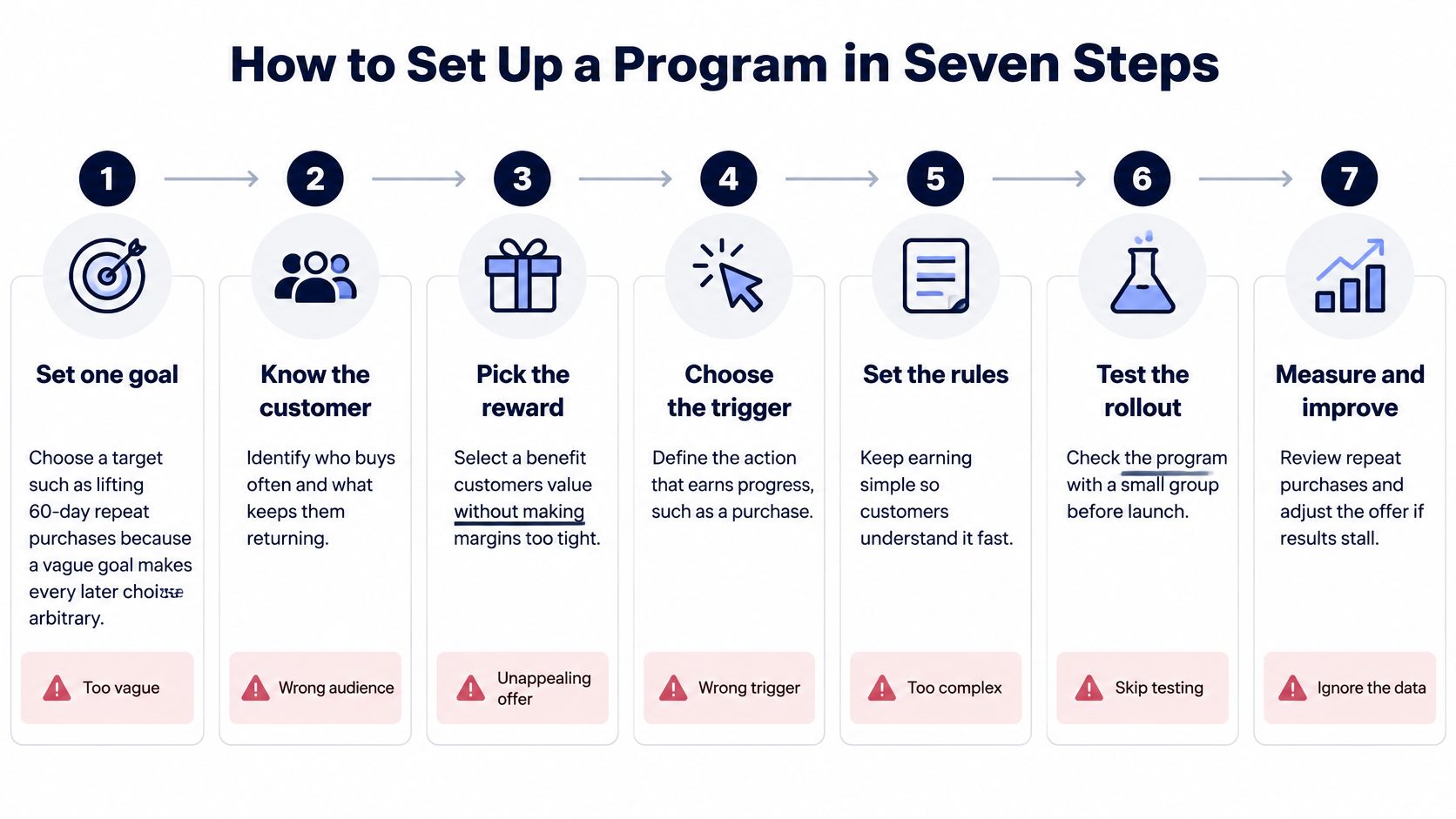
The order matters more than the tooling. Work through these seven and you'll have a program running inside a month; skip steps three and five and you'll spend that month answering complaints.
Set one goal. Something measurable, like lifting 60-day repeat purchases from 28% to 35%. A vague goal makes every later choice arbitrary, from the threshold to the budget. The common slip is picking the software first and inventing a goal that matches its dashboard.
Pick the model from your median purchase interval. Use the table, not your ambition. If customers return every 10 days, a stamp card earns its keep. If they return twice a year, store credit or a tiered reward does. The slip here is copying a competitor whose customers shop on a different rhythm than yours.
Define the events the system must recognise. Enrollment, qualifying order, reward issued, redeemed, expired, refunded, cancelled. A missing refund rule causes most disputes: the customer returns the item, keeps the stamps, and now you're arguing about a free drink. Decide where stamps go when an order is cancelled and write it into your terms.
Set a threshold reachable inside the purchase window. Then bolt on a minimum spend and exclude sale lines from earning, so the reward can't stack on top of a discount you already gave. Vague redemption rules are the second-biggest support cost after refunds, so publish a plain-language redemption page the way this points guide for Australian wine shoppers does.
Calculate reward liability before launch. Outstanding rewards multiplied by their cost, capped at a monthly figure you're willing to lose. The slip is discovering the number two months in, when the first cohort all qualify at once.
Choose the tool last. Either loyalty built into your store or a separate system, but confirm it attaches rewards to the same customer record that holds the order history. If you're weighing store setup generally, this online selling guide for small businesses covers the pieces around checkout. A program that can't see past purchases is guessing.
Launch to existing customers first. Not just new sign-ups. Your repeat buyers are the ones who'll fill a card, and their first redemptions tell you whether the threshold is right. Watch the first week of redemptions closely and adjust the threshold once, not five times.
A healthy first month looks like steady enrollment growth with a first wave of redemptions arriving inside the reward window. What you don't want is a launch spike followed by silence: that means people took the card and never came back, and the program has become a one-off discount with extra steps.
Rewarding Loyal Customers Without Crossing the Privacy Line

Most loyalty advice treats customer data as an uncomplicated route to better targeting. The evidence says the exchange is more fragile than that. Acxiom's 2025 brand loyalty study, surveying more than 2,000 consumers and 200 brands in the United States and the United Kingdom, found 67% of brands use customer data to tailor benefits and 45% use AI in that process, while 78% of consumers said adequate rewards make them more likely to stay loyal.
The same write-up cites a further industry survey finding that 69% of loyalty users had gone inactive because they didn't perceive enough value, even though 91% said personalised loyalty experiences are worthwhile. That's not a personalisation failure. It's a communication failure: people couldn't see what they were getting for what they handed over.
The minimum-data rule fixes most of it. Collect a name and a contact address so you can send the reward, order history so points calculate correctly, and nothing else. Skip birthdates unless the birthday reward is one of your better offers, skip income signals, and never infer anything about health, finances or family circumstances from purchase patterns.
The plain-language test: if a customer can't say in one sentence what they get in exchange for their details, the program is too complicated to trust.
Two operational habits carry the rest. First, ask for marketing consent separately from program enrollment, and keep a dated record of when and how each customer gave it, because untangling that later is painful. Second, build a deletion and correction path inside your store system, so a request doesn't turn into a scramble through inboxes.
If you sell across several markets, check each market's rules separately and have a lawyer review the final wording on your signup and privacy pages. Your own first-party data is valuable, but only while customers trust what you do with it.
Choose Your First Loyalty Program Model
Four questions decide this faster than any demo. How often does a typical customer buy? How much margin can you give up on each reward? What customer data do you already hold? And who, by name, will run the program every week?
Map the answers to a default. Short purchase intervals of a week or two point to a stamp card or a simple points scheme. High-ticket, infrequent purchases point to store credit or a tiered reward, because the perk has to stay attractive across a long gap between orders. Predictable repeat buying, the kind where a customer orders the same thing every month, justifies testing a paid membership, since you can price it against spending you can already forecast.
The margin answer sets the ceiling on generosity. A shop on thin margins does better with low-cost perks such as early access to new stock than with rewards that hand cash back. The data answer limits how personal the program can get: if all you hold is order history, a spend-based model is the honest fit.
Then the question that kills programs: ownership.
If nobody is named to check enrollment, redemptions and outstanding liability each week, the program decays while you assume it is running, and it becomes a discount you forgot you offered.
Pick one model and launch it within 30 days. Measure 30-day repeat purchases against your baseline, then change something at the 90-day review rather than defending the original design. Keep the commitment small: write the goal, the reward threshold and the reward liability limit on a single page before you open any tool.
For online stores, CIQRA Commerce runs loyalty points alongside its catalog, cart, checkout, promotions and returns portal, so the reward and the order that earned it sit in one place rather than in a separate loyalty app you reconcile by hand. Take the one-page brief you have just written to CIQRA and check whether the model you picked is already built in.