Search for how to start a t-shirt business and the first hundred results say the same thing: pick a niche, make designs, upload them, and wait for orders. That advice isn't wrong, it's just incomplete, and the missing part is where most new brands die. None of those guides tell you what a shirt has to earn after the blank, the print, the postage, the returns and the advertising that brought the buyer in.
Demand isn't the constraint. The global custom T-shirt printing market was valued at USD 5.2 billion in 2024, according to Grand View Research. The constraint is the distance between the price on your product page and the money that survives to your bank account. Build the business backwards from that number and every other decision, the design, the blank, the print method, the channel, gets cheaper and clearer.
Table of Contents
- Work Out the Profit on One Shirt
- How to Validate a Design Before You Print
- Choose a Production Model and Quality Check Process
- Set Up Your Store and Sales Channels
- Market the First Drop Without a Big Budget
- Confirm the Numbers Before You Reorder
Work Out the Profit on One Shirt
A $25 shirt is not a $25 sale. Before you buy a blank, put every cost on its own line and subtract it in order: garment, decoration, packaging, payment fees, the shipping you absorb, the returns you'll refund, and the advertising that brought the buyer in. Sellers who stop after the first two lines believe they're running 50% margins, and that belief survives right up to the first month of real orders.
Here's the same shirt costed properly.
| Cost per shirt | Typical range |
|---|---|
| Blank garment | $3 to $6, $4.50 in this example |
| Decoration (screen or DTG print) | $2 to $6, $4.00 here |
| Packaging and insert | $0.75 to $1.50, $1.00 here |
| Payment processing | About 3% plus $0.30, $1.05 here |
| Shipping you absorb | $3 to $7, $4.00 here |
| Returns allowance | About a fifth of sales, $4.78 here |
| Left before advertising | $5.67 here |
| Advertising cost per sale | $3 to $10, $5.00 here |
| Profit per shirt | $0.67 here |
The bottom line is $0.67 per shirt at a $25 price, and that assumes a decent day on ads. Drop the price to $22 and the shirt loses money. Switch to a heavier ringspun cotton at $6 and it loses money. This is the calculation that decides whether a business exists, and it takes twenty minutes in a spreadsheet.
Where the margin goes
Returns do more damage than new sellers budget for. A refunded shirt takes the outbound postage with it and often the garment too, because a printed tee can't go back on the shelf as new. Holding back roughly a fifth of sales as a returns allowance feels pessimistic until you've had a month where four orders in twenty came back for size.
Advertising is the line that separates a hobby from a business. $5 per sale is a solid outcome on cold traffic in apparel. At $10 per sale the same shirt clears nothing. That's why the profit table gets finished before the ad account is opened, not after.
The marketplace version of this math is harsher. An independent analysis of a representative print-on-demand Etsy listing found that a $21.70 customer payment left $5.37 before advertising and refunds once marketplace, production and shipping costs were deducted. The same analysis estimated average 2025 Etsy sales divided across active sellers came to about $156 per seller per month before costs. Publishing more designs changes neither number, because the constraint is fee structure and price, not catalogue size.
Run the numbers for each market you sell into
Taxes, delivery charges, payment fees and return postage all change with the destination, so a shirt that contributes $6 in one country can be underwater in another. Build the spreadsheet per market and price in local currency rather than converting at checkout, so the buyer sees a number that matches the charge on their statement.
Pricing comes before all of it. If you don't yet know what decoration should cost, Raccoon Transfers' guide to pricing custom shirts sets out how print cost, garment and quantity combine into a retail price, which is the right order of operations: cost first, price second.
The same contribution figure sets your advertising ceiling. The break-even ROAS calculation turns profit per shirt into the most you can pay to acquire one order, and it's the only number that should cap your ad spend.
The launch gate: a design moves forward when it keeps a positive contribution after a conservative returns allowance and a realistic cost per acquisition. If it doesn't, the fix is a different price, blank, print method or channel, never a better tagline.
How to Validate a Design Before You Print
Validation isn't a poll of your friends. It's a paid order from someone who has never met you, placed before you've paid for a print run. The sequence below fits into a month and costs less than a single 100-shirt order.
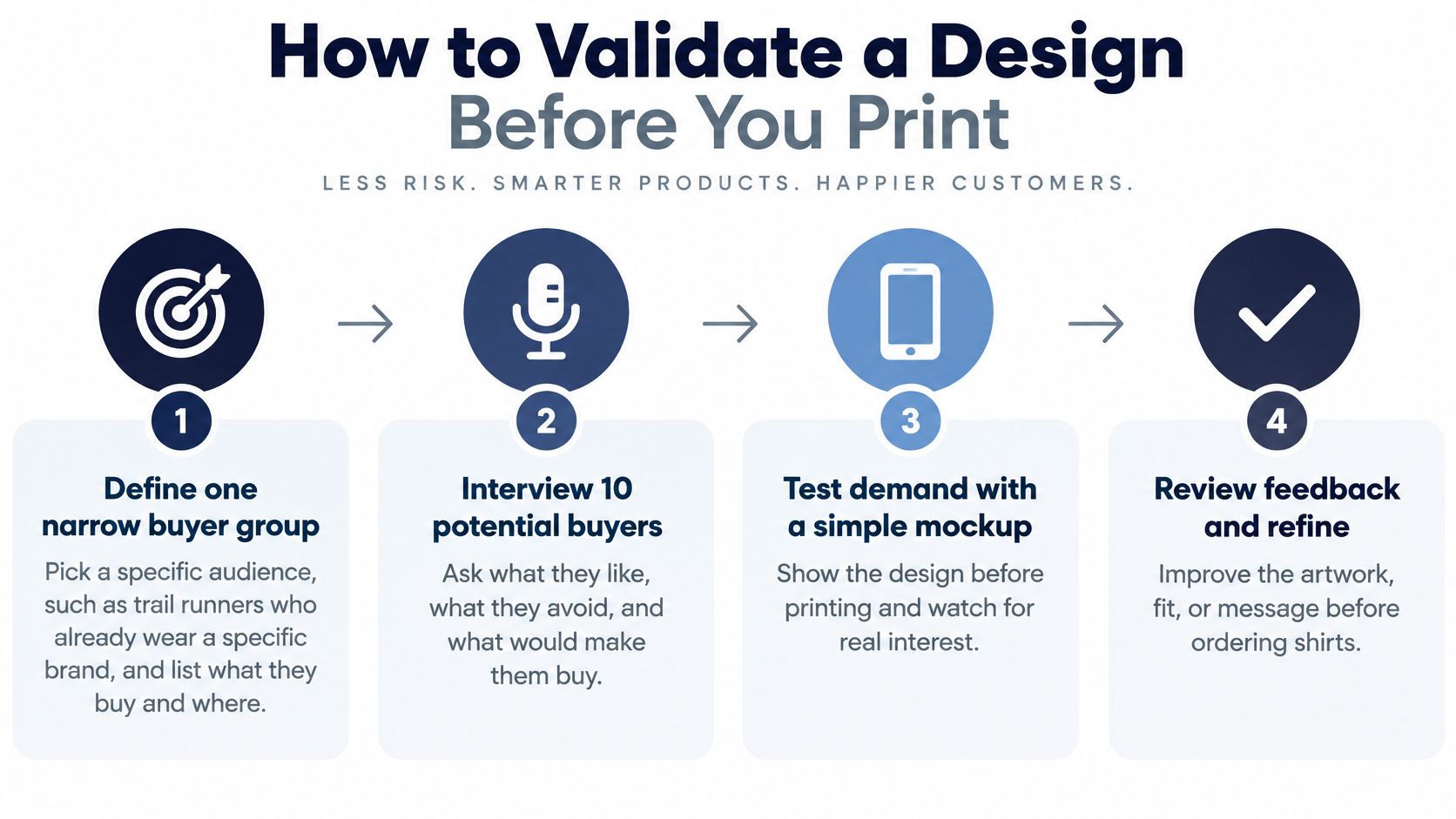
- Define one buyer group you can reach in one place. "Trail runners who already wear a specific shoe brand" is a buyer group. "People who like the outdoors" isn't. Write down what they already buy, where they buy it and which three accounts or communities they follow, because that list becomes your test audience. The usual slip is picking a group so broad that no message can speak to it.
- Interview 10 to 15 people from that group. Ask what they wear now, what they paid for their last tee, what stops them buying online and what would make them try a new brand. You're collecting language for the product page, not compliments. The slip is asking friends, who tell you what you want to hear.
- Mock up three to five concepts, not three to five products. Render each design on the exact blank colour and cut you'll print. The slip is approving artwork on a white mockup when the shirt you will use is navy, where dark ink disappears.
- Put real money behind a two-week test. A preorder at full price is the cleanest signal; a small paid social campaign is the second. Track signups, add-to-carts and paid orders separately per design, with its own landing page so the numbers don't blur. The slip is counting likes and saves as demand.
- Clear the rights before you pay for screens. Search the phrase or mark you're printing against the trademark register in the markets you sell into, and check for copyrighted characters, band artwork and logos. Cultural and political references deserve the same pause. The slip is a cease-and-desist arriving the week after a 200-shirt run ships.
- Order samples and wash one shirt per design. Wash it the way the care label instructs, dry it, then check print crack, colour fade, shrinkage and seam distortion. The slip is approving production from a photo.
- Produce only the design that sold. If preorders covered 30 shirts, print 40 and hold the rest as reorder headroom.
What a passing result looks like
Paid orders from strangers. Twenty people on an email list who said they'd buy and didn't are not a validated design, they're a nice conversation. If a concept gets strong saves and zero checkouts, the design is interesting and the offer is wrong, and no amount of extra printing will fix that.
Practical rule: test the design and the price together. A shirt that only sells at a launch discount has already told you what it's worth.
Choose a Production Model and Quality Check Process
Three setups sit in front of you, and the difference between them isn't quality, it's where your cash sits before a shirt sells.
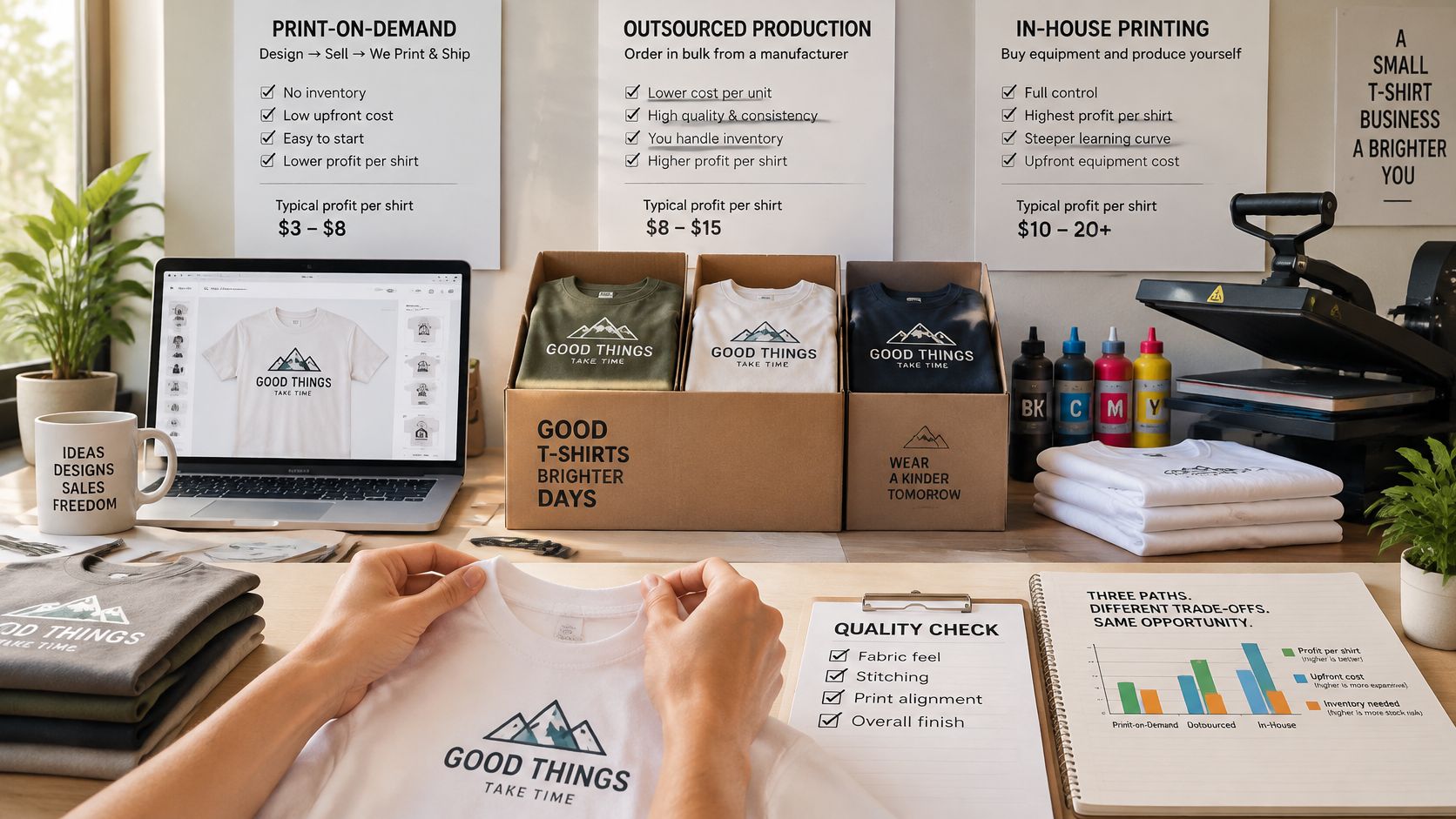
| Model | Upfront cash | Margin per shirt | Quality control | Best fit |
|---|---|---|---|---|
| Print-on-demand | None per design | Lowest, supplier fee on every order | Supplier samples only | Testing many designs with no stock |
| Outsourced batch production | Minimum run per design | Higher once the run sells through | Full, with approved samples and wash tests | Designs with evidence of demand |
| Local in-house printing | Printer, inks and workspace | Highest at steady volume | Full control on every run | Steady orders and a reliable team |
The quality routine that protects any model
Screen printing rewards recorded settings. The garment discharge printing guide from the Specialty Graphic Imaging Association places garment-discharge printing broadly at 60-196 lpi, with about 110 lpi a practical starting point, and notes that discharge inks generally cure around 149-177°C (300-350°F). Build a test matrix across light and dark garments covering wash durability, registration, opacity, hand feel and shrinkage, then log artwork separations, mesh count, squeegee settings, ink system, cure temperature, dwell time and fabric batch for every run so a defect can be traced back to a variable.
Never take a supplier's stated cure temperature as proof of durability. Wash-test it, and use a temperature strip or probe where you can. Photograph and approve a final sample before bulk production, then inspect a consistent sample from every batch that arrives.
Inventory decisions deserve the same scepticism. U.S. men's clothing stores generated $10.8 billion in sales in 2022, up 27.9% on 2021, one of the largest year-over-year increases in the Census Bureau's Annual Retail Trade Survey release. A single strong season is not permanent demand, which is why batch runs belong behind evidence, not ahead of it.
Before you commit to a model, source the blanks: request samples from two or three suppliers and compare fabric weight, shrinkage claims and minimum order quantities, then confirm that size and colour specifications stay identical across reorders. A factory quotes from a specification, not a PNG, so Genpire's tech pack template is worth filling in before you ask anyone for a price. If you're still deciding whether a supplier-held model suits you, what dropshipping means in practice explains the trade in control.
The pattern is consistent in every model, so price and inventory should reserve cash for return postage, reconditioning and unsellable goods. One benchmark cited in that same discharge guide puts fashion returns at 19.1%, against 17.6% for all U.S. online purchases.
Before you scale: every SKU, size, colour and print version has to be identifiable in your order system without manual guessing. If someone has to open a spreadsheet to work out which red was printed, the process isn't ready for volume.
Set Up Your Store and Sales Channels
Your storefront has one job before payment: remove the reasons a buyer hesitates. That's mostly a specification problem, and the payoff shows up in the returns column as much as in conversion.
The channel isn't the risk. U.S. retail e-commerce sales reached $1.1926 trillion in 2024, an 8.1% increase on 2023, and online sales accounted for 16.1% of total U.S. retail sales, according to the U.S. Census Bureau. Fashion is moving the same way: BigCommerce's 2024 global e-commerce report for fashion and apparel recorded a 10.7% global increase in gross merchandise value among fashion and apparel brands on its platform between Q1 2023 and Q1 2024. Your buyer already purchases clothes online. The question is whether your page answers what a fitting room would.
Build the product page around fit, not adjectives
- Measurements in both units: chest, body length and sleeve per size, in centimetres and inches, taken flat from a real garment rather than copied from a supplier sheet.
- A size chart tied to a body: state the model's height, chest and the size worn, so buyers calibrate against someone rather than a diagram.
- Fabric weight and composition: grams per square metre and fibre content, because a 150 gsm tee and a 220 gsm tee are different products at the same price.
- Print placement and scale: one photo of the print on a person, plus the measured width and position from the collar.
- Delivery timing and care: a realistic dispatch window by region, plus wash and dry instructions that match your testing.
Put the required details where shoppers look
Merchants on our platform are required to show on the storefront their identity and contact details, the total price including taxes and delivery charges, withdrawal information, complaint handling and legal guarantees. Those aren't footer boilerplate. Price and delivery belong on the product page, the full total belongs at checkout, and withdrawal rights and guarantees belong on the returns page, which is exactly where a hesitant buyer goes looking.
Then set your shipping and returns page: delivery estimates by region, the exchange window in plain numbers, and a clear statement of who pays return postage. Charging the customer for a return costs you more in chargebacks and reviews than the postage is worth.
Set the shop up in this order: domain and brand email, payment provider, shipping rates and zones, policy pages, then a full test order from cart through delivery, finishing with a test refund. If the refund takes three emails to complete, your customers will feel that too.
Start with one storefront and add marketplaces only after the margin works. If you're weighing a hosted store against marketplace and social channels, this guide to online selling tools and channels sets out what each one costs you in fees and control.
Market the First Drop Without a Big Budget
The most common launch mistake is waiting until the shirts exist before building an audience. Inventory is the last step, not the first, and a drop that sells to people who already asked for it needs no ad budget at all.
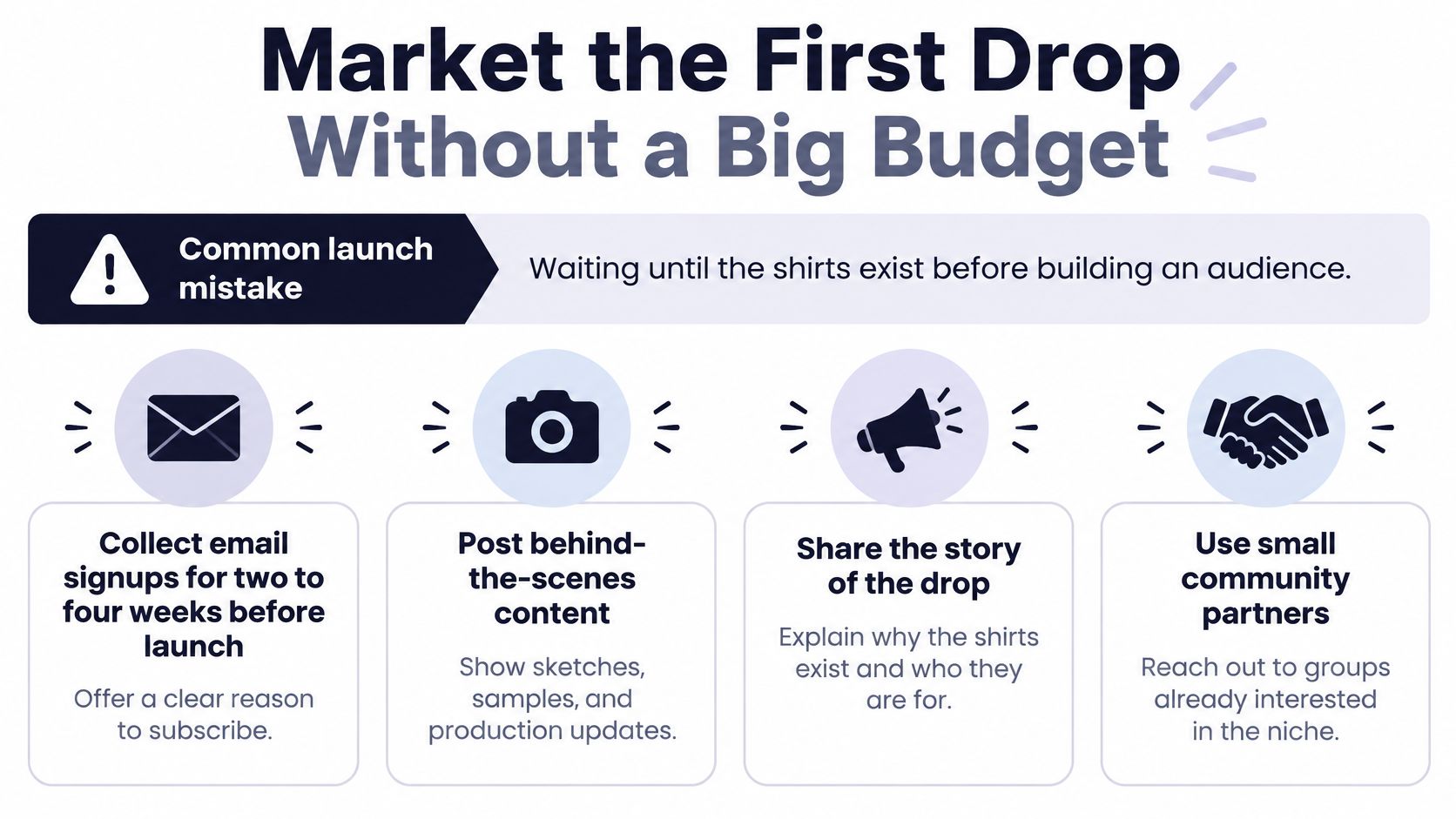
- Collect emails for two to four weeks beforehand. One page, one promise, one field. A launch-day email to a warm list outperforms a cold campaign every time, and it costs nothing to send.
- Send samples to 20 to 30 people who match the buyer group. Ask for photos of the shirt in use, at the trail, the court, the studio. Real-use photos answer fit questions in a way studio shots can't.
- Work with two or three micro-creators, each with its own discount code. One code per partner tells you which source produced the sale, so the next drop buys only the channel that paid.
- Film the printing. Screens, ink, the press and a wash test make a better quality argument than any product description.
- Run the drop for one week with a stated end date. Urgency beats a permanent discount, and it protects the price you costed in the first place.
- Record the source of every order. Referral, code, ad, email. The first drop is a test, and untagged sales teach you nothing.
Growth in the category won't rescue a drop nobody sees. The custom T-shirt printing market is forecast to grow by USD 2.23 billion between 2024 and 2029, at a compound annual growth rate of 7.7%, according to Technavio, and none of that reaches a brand whose only channel is an unvisited store.
Watch cost per order by channel during the drop, not after it. Any channel that pushes acquisition above the ceiling from your profit table gets paused that week, and the budget moves to whichever channel kept it lower. That habit, repeated every drop, is most of what separates a brand that survives year two from one that doesn't.
Confirm the Numbers Before You Reorder
A first drop that sells out doesn't justify doubling the order. It justifies a careful look at what sold, in which size and colour, and at what realized margin.
Pull sell-through by size and colour every week. Fashion retailers commonly use 60-80% sell-through as a benchmark, according to Shopify's retail benchmarks, which is a planning reference rather than a number the market owes you. A colourway sitting at 25% after launch gets cut, not expanded. A size that sold out in three days gets the reorder.
The three checks before a reorder
- It sold without a permanent discount. If the shirt only moves while a code is live, your real price is the discounted one, and the profit table needs rebuilding at that number.
- Unit economics held after returns and ads. Compare realized profit per shirt against the allowance you set before launch. If returns ran higher or acquisition cost more, fix the cause before adding stock.
- Size questions fell after measurements went live. If your inbox still fills with fit questions, the page needs work before more inventory arrives.
A reorder is justified by sell-through and profit per shirt, not by how good a design looks.
If all three checks pass, reorder the top sellers in small increments, cut the slowest colours, and test one new design in the next drop. If any check fails, change one variable at a time, price, size range or design, and rerun the test rather than the order.
Returns handling decides whether the second drop is affordable. Letting customers start their own returns, whether they're signed in or checking out as a guest, keeps the request out of your inbox, and sending a prepaid label straight from that request keeps the refund timeline honest. Our Shop plan covers this alongside the storefront, cart and checkout at $59.99 per month, or $49.99 per month billed yearly ($599.88 billed yearly).
For the next 30 days, build the cost tracker before you build the second drop. Every line from the profit table, one row per design, updated weekly with actual returns and actual acquisition cost. A brand that knows its contribution profit per shirt can reorder with confidence. One that only knows revenue is guessing.
CIQRA gives you a hosted storefront and commerce in one account, so a small apparel launch can carry a product catalogue, multiple currencies and a returns process without stitching two systems together. If you're working through the profit math for a first drop, you can build the store, run the test order and check the numbers in the same place. Visit CIQRA to see how the storefront and commerce tools fit a t-shirt business from launch through reorder.