
Small business websites are commonly quoted between $1,000 and $15,000 to build, before hosting, domains and upkeep, which add yearly costs. That range is the answer most pricing pages stop at, and it's the reason so many budgets go wrong.
Popular advice tells you to shop for the lowest launch price, as if a website is a one-off purchase like a printed brochure. It isn't. A cheap build that needs paid fixes, manual updates, a second language bolted on later, and a full rebuild when you start selling online can cost more over three years than a higher quote that covered those jobs from the start. The useful question isn't only what you'll pay to launch. It's what you'll pay to own, update, and change the site once real customers, staff, and legal obligations arrive.
Use the average cost for a website as a starting benchmark, not a final budget. Find your likely build range, identify what pushes you within it, then add recurring cash costs, staff hours, compliance work, and switching costs. That order stops a persuasive launch quote from hiding the larger bill.
Table of Contents
- Average Website Cost by Site Type
- What Moves a Quote Up or Down
- Choosing Between a Builder, Freelancer and Agency
- The Three-Year Cost of Ownership
- Accessibility, Privacy and Compliance Budgets
- Confirm Your Budget Before You Sign
Average Website Cost by Site Type
A website's quoted build price varies sharply with its scope and provider. The GoodFirms website construction cost survey, based on more than 100 web-development companies in 2024, found that 60% charged between $1,000 and $7,000 for a small-business site, while another 36% charged between $7,000 and $15,000.
Those figures describe provider quotes, not audited invoices. One quote may cover a template, five finished pages, and a contact form. Another may include custom design, copywriting, photography, CRM integration, search, approvals, and multilingual publishing. Treat the ranges as market benchmarks, not guaranteed prices for your scope, location, or supplier.
Typical Website Build Prices by Site Type
| Site type | Typical build price | Source | What the figure covers |
|---|---|---|---|
| Small business site, about 5 pages | $1,000–$7,000 | 2024 survey of 100+ web-development companies | Quoted provider range |
| Basic business site, 5–10 pages | $1,000–$15,000 | 2024 survey of 100+ web-development companies | Quoted provider range |
| Small business site by a design agency | $2,000–$9,000 | Forbes, 2024 | Agency or professional designer range |
| Five-page site, individual developer | $1,230 average | Clio Websites, 2024 global survey | Average across providers |
| Five-page site, agency | $3,196 average | Clio Websites, 2024 global survey | Average across providers |
| Online store (ecommerce) | Quoted per project after scoping | Provider quote required | Priced by catalogue size and checkout complexity |
For a five-page site, the Clio Websites web development pricing trend survey estimated a 2024 global average of $1,230 for an individual developer and $3,196 for an agency. These averages combine different labor markets, experience levels, and project inclusions, so a local written quote may differ substantially.
Practical rule: Match scope before comparing price. A lower quote that excludes content, integrations, testing, or training may cost more than a higher quote that includes them.
The store row has no single average because product data, variants, checkout rules, payment setup, tax handling, shipping logic, customer accounts, and returns all affect the work. A provider needs your catalogue and checkout requirements to quote responsibly. Ask what assumptions a headline store price includes and how later changes will be billed.
Timelines also vary. GoodFirms estimated development timelines of approximately 1–12 weeks for small-business sites and 2–12 weeks for broader business websites. Content readiness affects where a project falls within those ranges: finished text, approved images, product data, and a single decision-maker can keep work moving, while translations, legal review, or missing credentials can delay it.
Use the closest table row to set a provisional build budget, then compare quotes against the same scope. The 2026 website pricing guide offers broader small-business benchmarks for checking those figures.
What Moves a Quote Up or Down
Scope explains most of the spread inside any range. Two sites can both be called “five-page websites” while requiring completely different amounts of design, content, testing, and administration. Work through these factors before asking for quotes, because a provider can only price the requirements you state clearly.
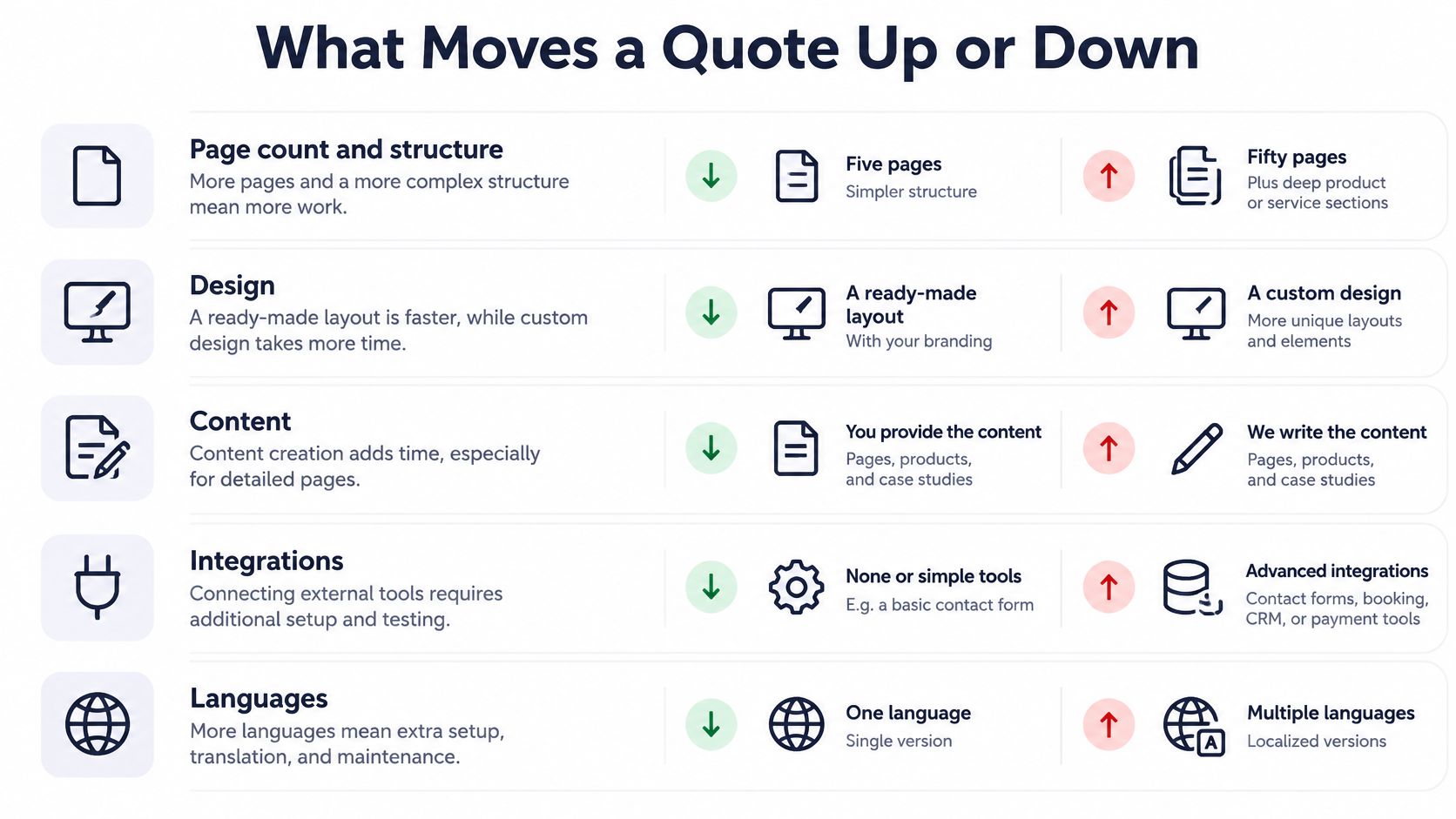
- Page count and structure: Five pages with one services overview sits at the low end, while fifty pages with deep product sections, case studies, locations, and internal search cost more to design, populate, and maintain. Extra structure also raises yearly content review work.
- Design: A ready-made layout adapted with your logo, colors, and photography costs less than a fully custom design with original illustrations, motion, and multiple approval rounds. Custom components can also raise future update costs because fewer staff can edit them confidently.
- Content production: Supplied, approved text and usable photos keep the quote down. If the builder must interview staff, write pages, source images, edit product descriptions, and manage approvals, you're buying a content project as well as a website, and refreshes continue after launch.
- Integrations: A simple contact form is low-end work. CRM connections, booking tools, payment gateways, file-upload enquiries, spam controls, and error handling add setup and testing. Each external system can also bring subscription fees, credential management, and support boundaries you need in writing.
- Languages: One language is the baseline. Every additional language adds translation, layout checks, URL and sitemap work, form messages, metadata, and ongoing updates whenever the source page changes. Say a dealership adds model pages monthly. Translation becomes an operating process, not a launch task.
- Commerce: A small catalogue with standard checkout is simpler than thousands of products with variants, bundles, customer-specific pricing, tax rules, shipping matrices, returns, and marketplace feeds. Commerce raises build cost and creates daily administration for prices, stock, orders, and customer questions.
- Accessibility and consent: Semantic templates and clean content reduce remediation. Complex menus, uploaded documents, product media, consent controls, checkout steps, and third-party widgets require separate testing and fixes. This factor affects launch cost and the yearly cost of publishing new content responsibly.
The cheapest quote often wins by describing less work, not by doing the same work more efficiently.
Mark each factor as included, excluded, or not yet decided on every proposal you receive. Then use the closing checklist to force providers to price the same scope, including the work that repeats after launch.
Choosing Between a Builder, Freelancer and Agency
The cheapest launch route can carry the highest ongoing cost in staff time. Compare the build price, recurring fees, and the work your team must handle after launch.
| Route | Upfront cost | Ongoing cost | Owner hours |
|---|---|---|---|
| Website builder (CIQRA Sites) | Plan fee from month one | $39.99/month, or $32.99/month billed yearly | High, you assemble and edit pages |
| Freelancer | $1,230 average, five pages (Clio, 2024) | Maintenance billed separately if agreed | Medium, briefing, content supply and review |
| Agency | $2,000–$9,000 | Maintenance quoted separately by scope | Low, agency handles the build |
A builder makes the subscription predictable, but your team supplies the content, selects images, checks forms, and keeps pages current. CIQRA Sites pages are built by stacking ready-made sections, filling them in and publishing, without a developer. The guide to programs for building websites explains how builders differ in page assembly, hosting, content management, and commerce functions.
A freelancer can reduce hands-on build work while keeping the project team small. Treat the five-page individual-developer average as a benchmark, not a guaranteed quote. Request a written price for your specific pages, integrations, revisions, and handover; clarify who holds admin access and how later updates are billed.
An agency combines design, development, and project management under one contract, with the price depending on scope. For B2B firms, web design advice from Big Moves Marketing offers context on what an agency process should clarify before design starts.
A builder may suit a stable, straightforward site without custom integrations. For distinctive branding, complex workflows, or custom features, compare freelancer and agency proposals against the same scope. Before signing, confirm who maintains the site, who owns the domain and content, and what happens if you change providers.
The Three-Year Cost of Ownership
A low build price doesn't prove a low website cost. Say you launch a five-page brochure site with a freelancer for $1,230, using the individual-developer average as a worked example. The next decision matters more than the launch invoice. Will you run updates, backups, security checks, content changes, and fixes yourself, or pay someone to manage them?

Two Routes After the Same Launch
Route A, self-managed: You pay the build, then roughly $200–$600 annually before professional labor for a self-managed small business site, according to the Digital Applied website development cost guide. That guide also places a managed maintenance plan at about $75–$500 or more per month depending on scope. The cash gap looks large, but Route A still consumes owner or staff hours. Price those hours carefully. Time spent fixing a form, resizing images, checking backups, or updating plugins is time not spent serving customers.
Route B, managed: You pay the same build, then $75–$500 or more a month, which is $900–$6,000 or more a year before extras. Over three years, even the low end can exceed the original build. That doesn't make managed support poor value. It means the contract must specify what's covered, response expectations, update frequency, backups, security work, and which content changes count as extra projects.
Now add the changes businesses commonly request after launch. In year one, you connect enquiry forms to a CRM. In year two, you add a second language. Ask for both as quoted line items rather than assuming they're “small tweaks.” Mark each item one-off or repeating. Translation repeats whenever source content changes, and an integration may bring subscription, monitoring, and troubleshooting work. Build your estimate in order: year-one build, recurring costs for years two and three, staff hours, then one contingency line for an unplanned fix.
Recurring Website Costs After Launch
| Recurring item | Typical cost | Usually paid by |
|---|---|---|
| Self-managed small business site | $200–$600 a year before labour | Owner |
| Managed maintenance plan | $75–$500+ a month, depending on scope | Agency or provider |
| Domain, hosting and email | Annual renewal per registrar, host and mailbox quote | Owner |
| Content updates and SEO | Staff time or hourly and per-task provider quote | Owner or paid freelancer |
| Migration if the site outgrows its platform | One-off rebuild or migration quote based on content volume | Owner |
Platform subscriptions can bundle hosting, security, and updates into one recurring payment, while agency maintenance is usually billed separately from the build. On our platform, for example, Site and Shop plans can be billed monthly or yearly, while Enterprise plans are annual agreements. The services work with Stripe for payments, Microsoft Azure for hosting, and Cloudflare for content delivery and security. Those arrangements simplify vendor management, but you should still confirm domains, email, third-party apps, content work, and specialist SEO separately.
Content and search work deserve their own line because publishing doesn't end at launch. Product changes, service pages, case studies, metadata, internal links, and conversion tracking all take time. If you'll outsource search work, reviewing typical hourly rates for SEO helps you challenge vague monthly retainers and ask what deliverables the fee buys.
Switching cost is the item most three-year budgets miss. Say a multilingual retailer starts with an informational site, then adds a catalogue in year two on a separate system. Staff duplicate product content, customers cross between properties, and the eventual migration needs redirects, design rework, data cleanup, testing, and time to recover search visibility. That rebuild can dominate the original savings. Our breakdown of the real cost of free ecommerce shows why “free to start” can become expensive once operations grow.
Compare every option on yearly cost plus staff hours plus switching cost. That metric reveals whether you're buying a durable operating setup or merely postponing the expensive decision.
Accessibility, Privacy and Compliance Budgets
Accessibility isn't a decorative upgrade you add when money is left over. It's lifecycle work that affects templates, content, media, forms, checkout, consent, and every future page your team publishes. Budgeting it as a vague percentage of design hides the actual tasks and makes it easy for a quote to exclude testing or remediation.
| Site type | First-year accessibility work | Ongoing monitoring |
|---|---|---|
| Typical 10–50 page small business site | $5,000–$25,000 | $2,000–$5,000 a year |
| Ecommerce site | $25,000–$35,000 | Annual monitoring quoted by checkout and catalogue scope |
Those planning ranges come from Andava's web accessibility statistics and cost guidance, which places first-year accessibility work for a typical 10–50-page small-business site at approximately $5,000–$25,000, ongoing monitoring and maintenance around $2,000–$5,000 annually, and ecommerce sites at $25,000–$35,000 initially. State them plainly in your budget as consultancy estimates, not a universal market average or guaranteed quote. Your actual scope depends on the current site, target standard, content volume, and how much remediation your own team can perform.
Where the Money Goes
- Requirements discovery: Confirm which markets, procurement rules, policies, and user needs apply before design decisions harden.
- Content and interface remediation: Fix heading order, labels, focus states, contrast, keyboard paths, image alternatives, documents, and error messages.
- Testing: Check real journeys with assistive technology and keyboard navigation, not only automated scans.
- Monitoring: Recheck templates and new content after releases, campaigns, catalogue imports, and third-party changes.
- Governance: Assign owners, approval checks, training, issue tracking, and evidence of fixes.
Specific features create separate testing obligations. Multilingual pages need translated labels and announcements, forms with file uploads need understandable errors and status messages, and product images need useful alternatives. Checkout flows combine forms, payments, addresses, discounts, and confirmation states. Consent controls and third-party payment or marketing integrations add interfaces you may not fully control, so vendor behavior belongs in the test plan.
Legal requirements differ by market, so budget legal review separately from tooling or remediation. A scanner can find some code issues. It can't decide your privacy notices, retention approach, consent wording, or contractual responsibilities. If you sell online, our GDPR checklist for online stores gives you an operational starting point for questions to take to qualified advisers. We provide tax-calculation and invoicing aids as tools, but these do not take over the merchant's legal obligations.
Retrofitting is usually disruptive because teams must revisit finished templates, thousands of product assets, translated content, and live checkout steps while the site keeps trading. Building accurately from the start spreads the work into design and publishing. Set two lines before launch: first-year remediation and annual monitoring. If a provider can't explain what each line buys, compliance isn't in the quote.
Confirm Your Budget Before You Sign
Turn competing proposals into the same shopping list before you compare totals. A provider who won't itemize scope is asking you to fund the unknowns later, when changing supplier is harder and launch pressure makes extras easier to approve.
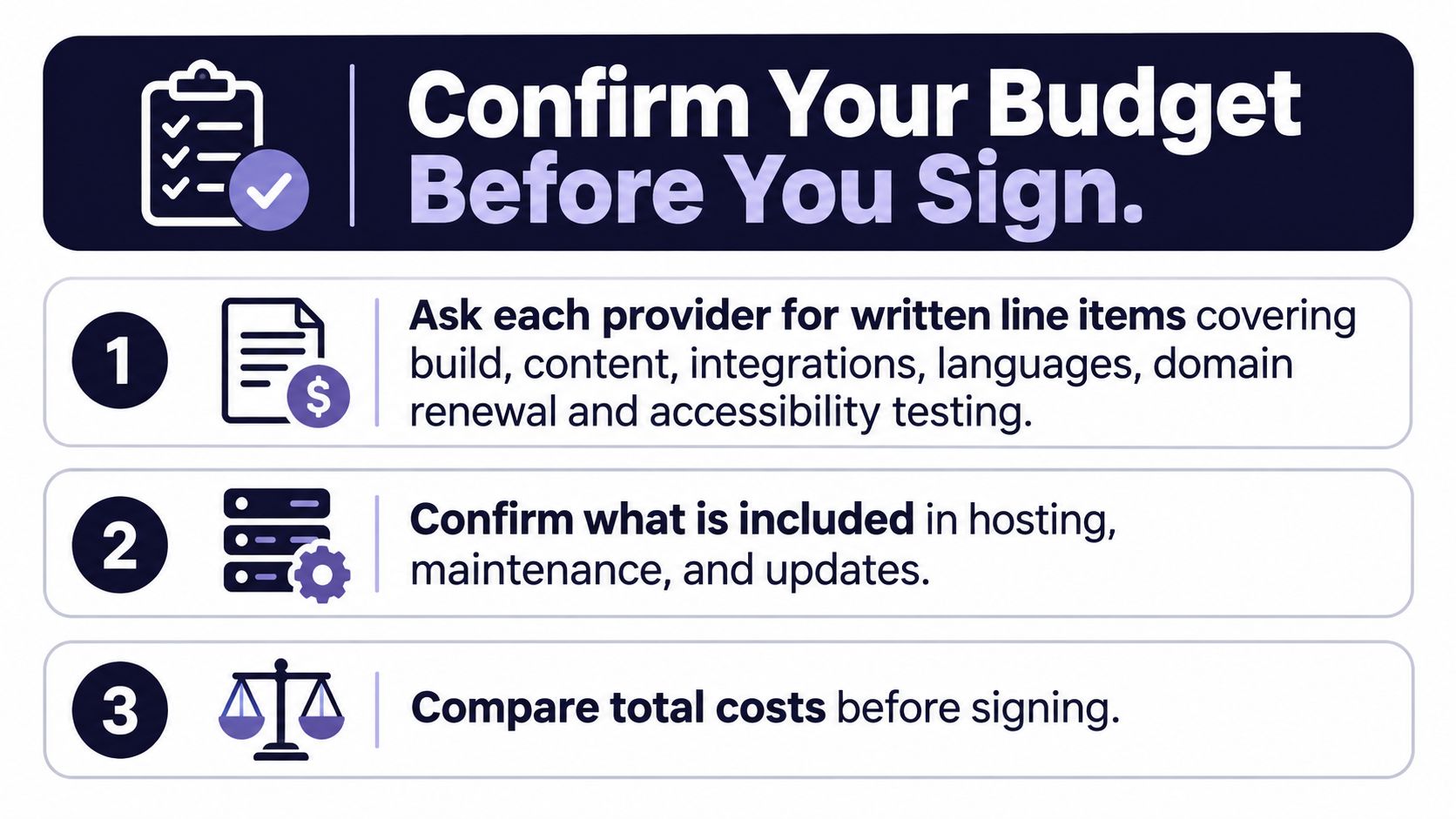
- Demand written line items: Ask each provider to price build, content, integrations, languages, domain renewal, accessibility testing, training, and launch support separately.
- Confirm operating responsibilities: Get hosting, security, updates, backups, restore process, support boundaries, domain ownership, and content ownership in writing.
- Compare three-year economics: Rank quotes by yearly cost plus staff hours plus switching cost, not the launch price. Include likely year-two work, such as a language, catalogue, booking flow, or CRM change.
- Check plan fit against real needs: Confirm languages, team members, custom domains, storage, forms, commerce, and approval controls before the first payment, not after your team hits a limit.
For a business that needs a website and online shop managed in one place, CIQRA is one option to evaluate against that checklist. Our Shop plan costs $59.99 per month, or $49.99 per month billed yearly ($599.88 billed yearly). Our Site plan includes AI writing and image tools, server-side conversion tracking, an AI copilot for your team, 3 languages, 3 team members, 1 custom domain, 10 GB of media storage and 2,000 AI credits a month. These are list prices in USD, with other currencies shown on the pricing page. Fit still depends on your language, user, domain, and store requirements, so don't buy a tier only because the monthly figure looks small.
Budget test: If removing one feature changes who does weekly work, it's an operating decision, not a cosmetic feature choice.
Do one concrete task this week. Take the row closest to your project, add three years of recurring costs, price your staff hours, include compliance and a contingency line, then confirm the total with at least two providers. Sign only when both quotes describe the same build, the same responsibilities, and the same exit terms.
If you want your company website and online shop managed in one place without planning a later migration, explore CIQRA and compare the Site and Shop plans against your three-year checklist. Bring your page count, languages, integrations, and ownership questions, then choose the setup your team can maintain.