
In 2024, nearly 75% of consumers said inaccurate or incomplete product content negatively affected their perception of a brand, according to Syndigo's State of Product Content study reported by Total Retail. That changes the job of a product description. You're not just making an item sound desirable. You're helping someone decide whether it belongs in their home, wardrobe, vehicle or business.
Learning how to write product descriptions starts with a practical rule: put the benefit next to the evidence, and put the limit where the buyer can't miss it. A persuasive line that hides a sizing restriction or care requirement can win an order that should never have been placed.
Table of Contents
- The Block Order Shoppers Can Scan
- Write the Description in Five Passes
- Facts and Limits That Prevent Returns
- Search, Images and Variant Labels
- Check, Measure and Rebuild One Product
The Block Order Shoppers Can Scan
Give buyers a predictable route through the page: identity, benefits, specifications, fit, contents and constraints. Someone comparing products should be able to locate a dimension without reading your brand story, while someone unfamiliar with the category should still understand why that dimension matters.
Start with a plain-language summary naming the product and its intended buyer. Follow with a compact set of benefit lines, each attached to a verified attribute. Then separate comparable specifications from explanatory copy, so shoppers don't have to extract measurements from paragraphs.
What each description block must do
| Block | Job for the shopper | What to put in it |
|---|---|---|
| Opening summary | Identify the product in a short opening | What it is, who it is for, one concrete outcome |
| Benefit lines | Connect attributes to use | A short set of outcomes, each with the fact behind it |
| Specification block | Make products comparable | Dimensions, materials, weight and compatibility, with units |
| Fit, contents and use | Show whether it will work | Sizing or compatibility, included items and realistic use cases |
| Limits, care and returns | Prevent a mismatch | Exclusions, care, warranty, colour variation and unsuitable uses |
This isn't a choice between informative copy and attractive copy. In its March 2021 review, the Baymard Institute reported that 10% of the largest ecommerce sites failed to provide consistently sufficient product-description detail, while 90% maintained a high level of quality and consistency. Treat missing dimensions, materials or care instructions as a catalogue defect, not a matter of writing style.
Build the page around a real decision
Say you're preparing a wool-blend throw listing. The opening should identify it as a sofa throw for indoor use, rather than starting with a vague promise about transforming a living space.
If the supplier confirms its dimensions, weight and wool content, put those values in the opening or specification block with their units. Don't infer warmth, softness or washability from the word wool. Check the composition and care label before describing how it feels or how customers should clean it.
A useful arrangement would be:
- Opening: Identify the wool-blend throw, its intended use and its size.
- Benefit: Explain its suitability for draping over a sofa, supported by its dimensions and construction.
- Specifications: State composition, finished measurements and product weight, clearly distinguished from shipping weight.
- Boundary: Put any hand-wash or dry-clean restriction beside the comfort benefit, not behind an unrelated delivery tab.
The layout matters too. A technically complete page can still be frustrating if the specification table disappears on mobile or the care tab has an unclear label. Apply the principles in our guide to user interface design in ecommerce to make those blocks easy to find and operate.
Practical rule: Support shouldn't have to explain what the product is, who it's for, whether it fits or works, what's included, or which constraints apply.
Keep those questions beside your editing screen. They're a more useful completion test than whether the description sounds polished.
Write the Description in Five Passes
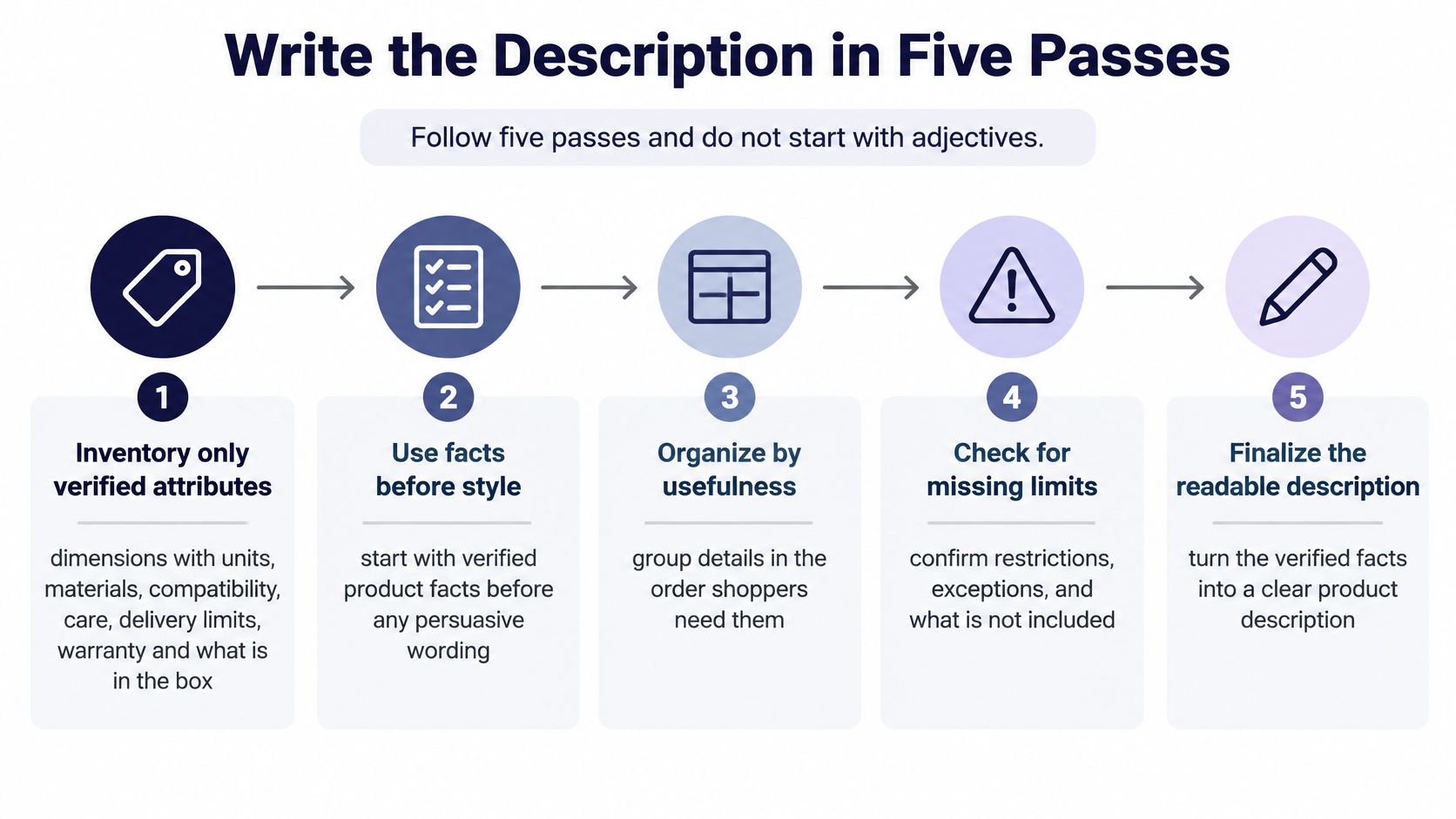
Don't start with adjectives. Start with a source sheet that separates confirmed facts from unresolved questions, then write in passes so you're not checking compatibility while trying to invent a compelling opening.
The sequence below keeps factual work ahead of stylistic work.
Establish the facts and the customer outcome
Inventory only verified attributes. Collect dimensions with units, materials, compatibility, care, delivery constraints, warranty terms and box contents. Use the current specification sheet, packaging information and approved technical documents, not a previous listing that may describe a different variant.
Record where each fact came from. If the supplier gives package dimensions but not assembled dimensions, label that gap explicitly rather than publishing the package size as the product size.
Translate attributes into useful outcomes. Ask what the attribute lets the buyer do, then check whether that outcome follows. A removable cover may make cleaning more convenient, but it doesn't establish that the cover is machine washable.
For a chair intended for a home office, a verified seat-height range can support a benefit about adjusting the seating position. It can't support a promise to eliminate back pain. Describe the practical result you can defend, not the result that sounds most persuasive.
Attach evidence and remove overreach. Put the relevant material, measurement, test condition or construction detail beside the benefit. Delete premium, best and indestructible when you can't explain what makes the statement true.
Watch for compound claims. A bag may have water-resistant fabric without being waterproof at its seams or zip. The evidence for the fabric doesn't automatically establish performance for the finished bag.
A study of 3,544 UK DIY shoppers found that product-information quality affected online-shopping outcomes, with particularly high requirements for readable titles, product depiction and comparability, according to the University of Surrey journal record. Give complex or high-involvement purchases enough explanation to support evaluation. A replacement washer doesn't need the same treatment as an appliance installation kit.
Organise and verify the finished draft
Arrange information by usefulness. Use short prose for context and bullets for facts someone might compare. Keep related measurements together, use consistent labels across sibling products, and separate optional accessories from supplied components.
Baymard's ecommerce UX guidance, drawing on more than 200,000 hours of UX research, recommends combining bullet lists and text blocks rather than relying on either format alone. A specification list helps someone locate facts; prose explains the circumstances in which those facts matter.
Run factual, consistency and localisation checks. Compare the draft against the source sheet line by line. Lock model names, technical values, units and approved claims before translating benefits, and keep the same information blocks across language versions.
Don't let a translation turn water-resistant into waterproof or wool-blend into pure wool. Give translators a terminology list and identify words that must remain unchanged, including model codes and connector names.
For an additional editorial checklist, the product description tips from Next Point Digital offer a useful companion resource. Use writing advice to improve expression, while keeping the approved source sheet as the authority for product claims.
Finish with a reverse check: highlight every statement that promises an outcome. If you can't identify the supporting attribute or evidence, qualify it, verify it or remove it.
Facts and Limits That Prevent Returns
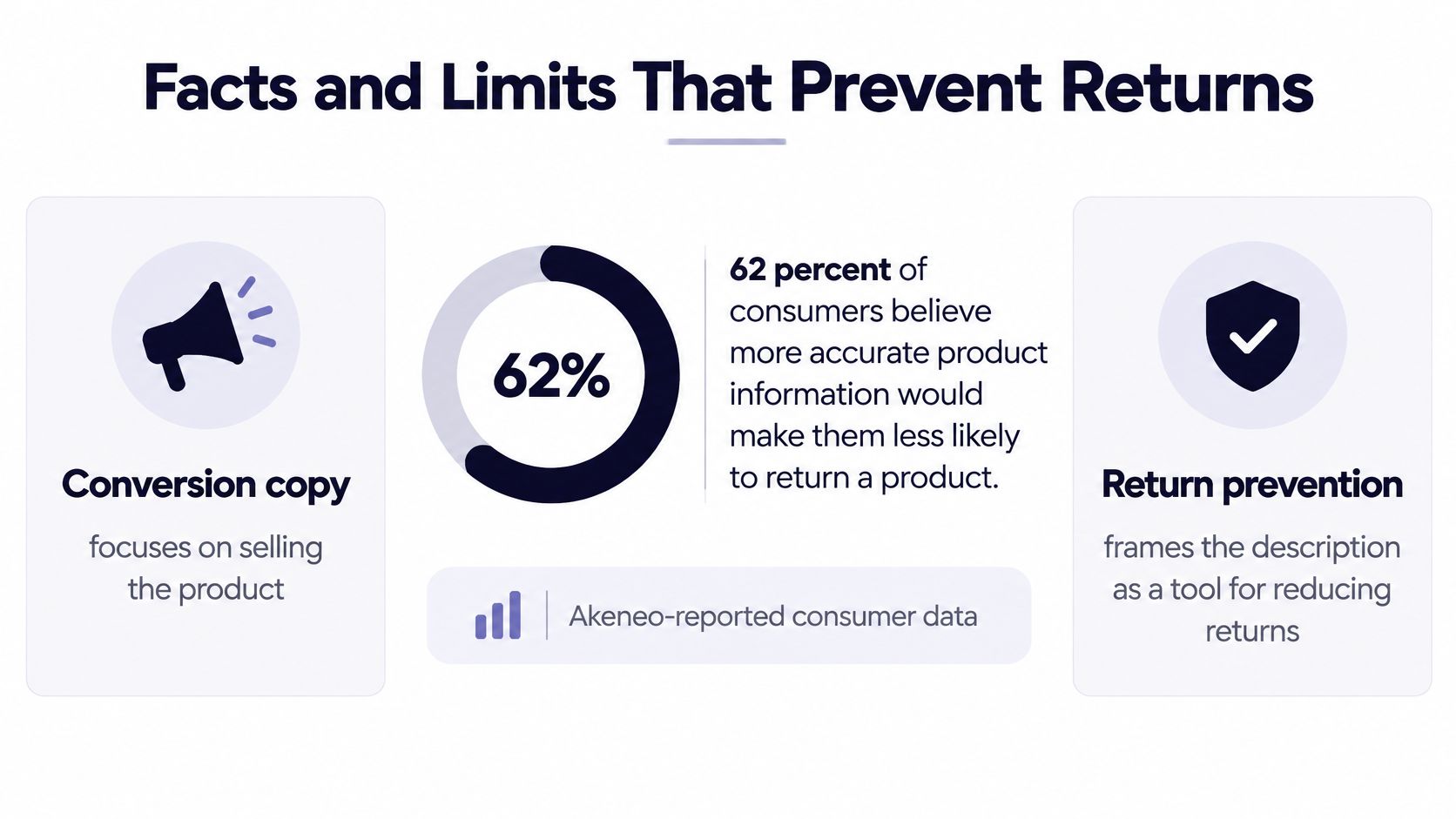
62% of consumers say more accurate product information would reduce their likelihood of returning an item, while 59% report returning something because an online description was misleading or inaccurate, according to Akeneo's consumer findings. Those are reported consumer responses, not a forecast of how much your store's returns will fall.
The editorial implication is clear: write about the mismatch that could happen after delivery. A buyer needs to know not just why the item is appealing, but what could make it unsuitable.
Put the boundary beside the promise
Consider a commuter bag described as lightweight. That benefit isn't enough to decide whether it works for someone carrying a laptop, charger and work clothing.
State the verified carrying capacity, internal device-compartment dimensions and weather-resistance limits. If the bag's fabric resists light rain but the closure isn't sealed, don't let a lifestyle photograph imply all-weather protection.
A useful benefit-and-limit pairing might read:
Carry your work essentials in a compact bag with a dedicated device compartment. Check your device against the internal compartment measurements; the bag isn't intended for prolonged exposure to heavy rain.
That's a hypothetical wording pattern, not permission to publish unverified claims. Replace each statement with the product's confirmed details, and remove the weather claim altogether if you have no supporting information.
Decision facts by product type
| Product type | Facts to state | Mismatch they prevent |
|---|---|---|
| Clothing and fashion | Garment measurements, fit behaviour, fabric feel and colour variation | Buyer chooses a familiar size label that doesn't match the garment |
| Home and living | Width, depth, height, weight, assembly requirements and excluded items | Product won't fit the space, or buyer expects accessories that aren't supplied |
| Automotive | Compatible models, operating conditions and what isn't covered | Buyer selects a part for the wrong vehicle or intended use |
| B2B and industrial | Specifications, lead time, inclusions and exclusions | Quote, installation requirements or supplied equipment differ from expectations |
| Low-risk commodity | Short copy with units and actual contents | Buyer misunderstands pack contents or expects unsupported performance |
Use return reasons as editing instructions
Read return comments for specific expectation failures. Too small might mean an inaccurate size chart, unclear garment measurements or a photograph that obscures scale. Those require different corrections.
For clothing, distinguish body measurements from garment measurements. Explain whether the stated measurements are taken flat, whether the material stretches, and whether the cut is intended to be close-fitting or relaxed. Don't use true to size as a substitute for a measurement method.
For furniture, separate assembled dimensions from carton dimensions and check whether handles, feet or extending sections affect clearance. If cushions or styling accessories appear in the image but aren't supplied, say so in the contents block.
Return-prevention copy also needs to agree with the buying terms. Use our ecommerce returns policy guide to align the page's care, exclusions and returns notes with the policy customers will encounter.
Persuasive copy can attract unsuitable orders when it amplifies aspiration and conceals constraints. Accept that a clear limitation may persuade the wrong buyer not to purchase. That's a better outcome than a disappointed customer discovering the limitation after delivery.
Search, Images and Variant Labels
75% of online shoppers rely on product photos for purchase decisions, while retail sites averaged 14 inaccessible images per page, according to AudioEye's 2025 retail accessibility analysis. Product photography deserves attention, but the description must still work when someone can't access or interpret the image.
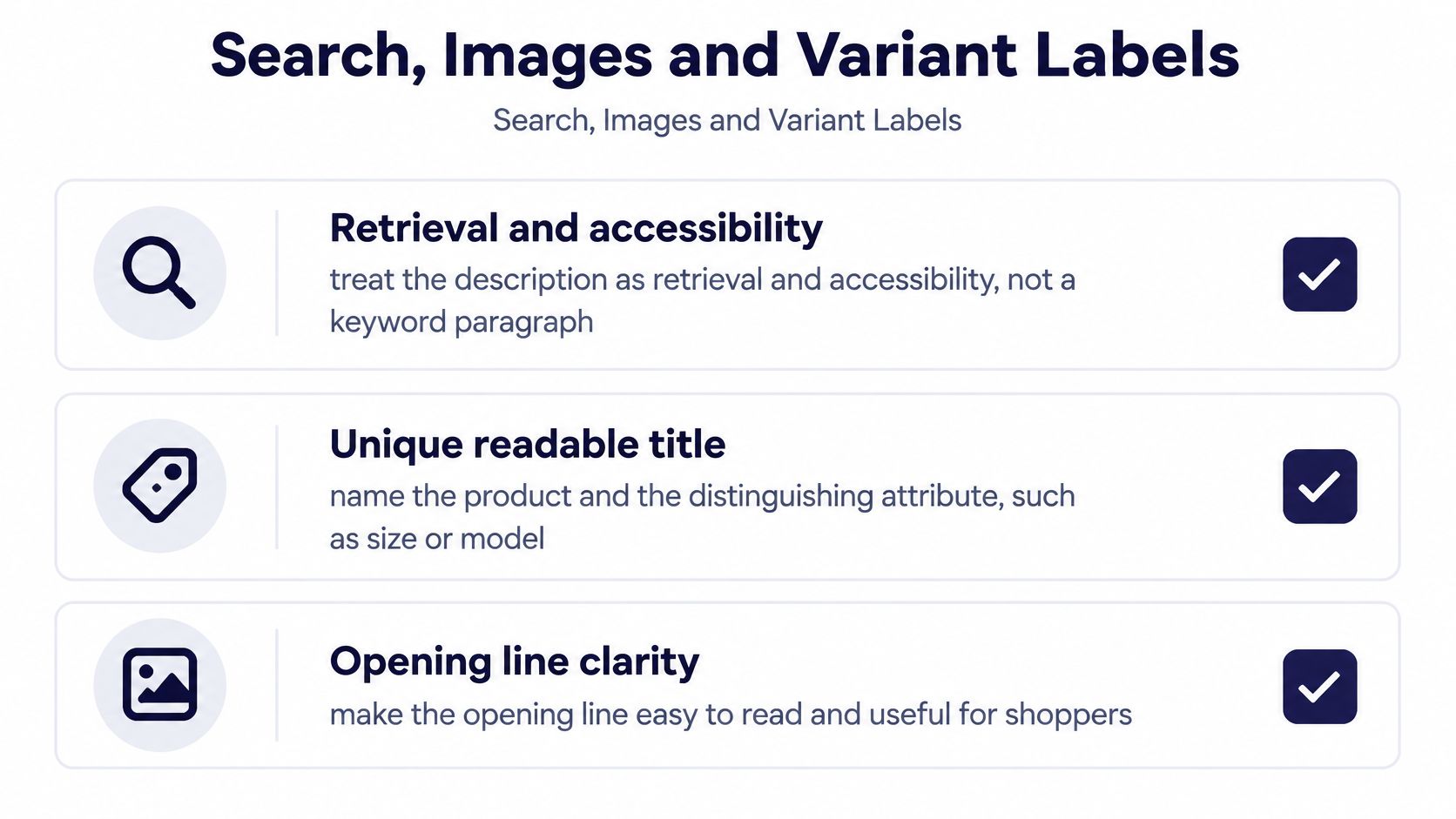
Before editing keywords, check whether the page states the product's identity, colour, material, dimensions and contents in accessible text. A size diagram can supplement those facts. It shouldn't be their only location.
Describe what the shopper needs to distinguish
Write a readable title using the product type and its distinguishing attribute. Oak side table with lower shelf identifies more than a collection name alone. The opening sentence can then explain the intended use without repeating the entire title mechanically.
Keep image descriptions factual and specific to the image:
- Product view: Describe the relevant colour, material, shape or visible construction.
- Detail view: Identify what the close-up demonstrates, such as a zip closure or textured weave.
- Scale view: Explain the context without assuming the shopper can infer exact dimensions.
- Decorative image: Mark it as decorative when it contributes no product information.
Don't put promotional slogans into alt text. Someone navigating images needs to distinguish a front view from a fastening detail, not hear the same sales line repeatedly.
Variant controls need equally meaningful labels. Use colour names, sizes, materials or model identifiers instead of Option A and Option B. If a colour has a branded name, pair it with a recognisable colour description so the buyer doesn't have to interpret the swatch.
Match search language without changing product identity
Buyers don't always use your catalogue terminology. Robosize's discussion of using synonyms in shirt searches is a useful prompt to consider alternate wording when reviewing apparel search terms.
Use those alternatives only when they describe the item accurately. A blouse and a shirt may overlap in customer language, but a keyword opportunity doesn't justify relabelling the product or obscuring its cut.
Answer the particular question behind the search. For a replacement part, that might be whether it fits a named model. For a dining table, it might be whether it extends, and what clearance the extension needs.
Search-friendly copy should help a buyer recognise the right product, not make the product sound relevant to every query.
Check the machine-readable fields alongside the visible text. The selected variant, price, availability and product attributes should agree across the page and its sales-channel feed. Our Google Shopping product feed guide provides a practical reference for reviewing that connection.
Finally, inspect the rendered page on a phone and use its controls with a keyboard. Confirm that headings make sense, specification labels remain readable, and changing a variant updates the information the buyer needs.
Check, Measure and Rebuild One Product
A polished description can still be wrong. Review the draft against accuracy, relevance, timeliness, completeness, consistency and presentation, rather than judging it only by tone.
Market context matters as well. A 2021 cross-continental review of product descriptions reported differences in how consumers across markets interpret and value them. Localisation needs an editorial check of terminology, measurement conventions and compliance wording, not just fluent sentences.
Use a publication gate
Ask a colleague who didn't write the description to evaluate it without opening the supplier document. Give them a buying scenario, such as choosing a replacement component or checking whether furniture fits through a doorway.
Have them identify the item, intended user, fit or compatibility, supplied contents and constraints. If they can't answer from the page, mark the missing information before approving the copy.
Use a release checklist that catches concrete failures:
- Variant match: Confirm every dimension, image and material claim applies to the selected product.
- Unit clarity: Distinguish product weight from shipping weight and internal dimensions from external dimensions.
- Current information: Recheck changed materials, revised accessories, discontinued compatibility and delivery statements.
- Claim integrity: Reject unsupported superlatives and performance claims copied from another product.
- Translation fidelity: Compare safety, materials and operating restrictions against the approved original.
- Readable presentation: Inspect the actual page, including tabs, tables, controls and mobile formatting.
Keep one source sheet for technical values, with a named owner and an approval status. When a supplier changes the product, update that record before anyone rewrites the description or translates the changes.
AI output belongs behind the same publication gate. Our AI drafts product copy, SEO text, alt text, product translations and llms.txt, and the store chooses what goes live. The customer remains responsible for reviewing and checking the output before publishing or relying on it, including descriptions, translations and images.
Measure the order quality, not just the click
Choose a live product that repeatedly generates size, fit or compatibility questions. Save its existing description and record the publication date of the replacement so you can distinguish versions.
Track search impressions, product-page engagement, add-to-cart rate, returns and recurring customer questions. Read the actual questions and return reasons alongside the totals. A reduction in compatibility enquiries means something different from a drop caused by fewer visitors.
Be careful with before-and-after comparisons. Changes in price, stock, advertising or season can affect the result, so record those changes and avoid attributing everything to the copy. Where traffic allows, a controlled comparison is more informative than replacing copy across the whole catalogue at once.
Don't declare success because add-to-cart rate improves. Check whether buyers keep the item and whether the same avoidable questions disappear. Allow the relevant orders enough time to arrive and pass through the applicable returns period before drawing conclusions.
Rebuild the chosen product in scan order, add the constraint missing from a recent mismatch, and publish only after another reader can make a sound buying decision from the page. Review its returns and customer questions over a suitable selling period before applying the template to the rest of the category. Keep the useful structure, but don't copy product-specific promises into unrelated listings.
CIQRA offers structured product specifications, product-page questions and answers, and AI-assisted drafting and translation for catalogue content. Visit CIQRA to explore how you can organise product facts, prepare clearer descriptions and keep publication decisions with your store. Start with a product that attracts fit or compatibility questions, and review every claim before it goes live.