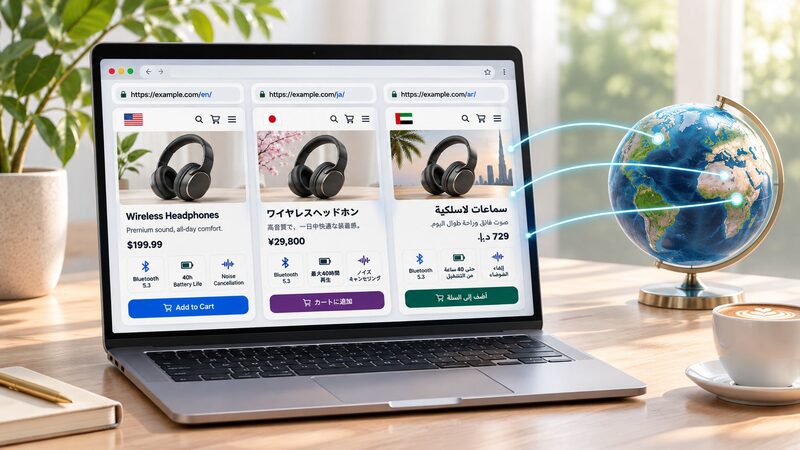
If your return page only tells a shopper how many days they have, who opens the parcel, and on which day does the money move? A useful sample return policy answers those operational questions. It names the person or team that handles the item, the checks they run, and the moment a refund is approved. A day count alone is not a promise your warehouse can keep.
Vague wording is expensive. In the United States, Appriss Retail reported that online purchases, including buy-online-return-online and buy-online-return-in-store, came back at 24.52% in 2024, against 8.72% for in-store purchases. Support staff cannot settle that volume from a fuzzy paragraph. Shoppers also decide, before they pay, whether a return looks workable. Write each clause so it matches what the store really does, then have a lawyer read the final text for every country you sell into.
Table of Contents
- Sample Return Policy at a Glance
- Copy-Ready Sample Return Policy Template
- Return Rules by Market Under EU and US Law
- Return Window and Eligibility Clauses
- Exclusion Clauses for Personalized and Hygiene Goods
- Refund Timing and Payment Clauses
- Return Shipping Cost and Method Clauses
- What Happens to Returned Items
- Abuse Controls, Fraud Checks and Appeals
- Link, Check and Publish Your Return Policy
Sample Return Policy at a Glance
A sample return policy is the published statement of when a customer may send an item back, what they receive, and who pays the postage. Treat any template as a starting draft, not a finished legal document. The legal floor changes by market, and the sentences have to describe your carriers, your inspection, and your payment provider.
Fill every row below with your own value before you copy wording. Number the clauses, and make the helpdesk and the public page cite the same numbers.
| Clause | Minimum to state | Common default |
|---|---|---|
| Return window | Number of days and the day the count starts | 14 to 30 calendar days from delivery |
| Eligible condition | Unused items, tags and original packaging | Unworn and resaleable |
| Excluded products | Personalized, perishable and sealed hygiene items, named individually | Listed by name |
| Return request | Channel and steps to start a return | Online form or email |
| Refund timing | Deadline counted from receipt or notice | A fixed number of days from receipt or proof of sending |
| Refund method | Original payment method | Original payment method |
| Return postage | Who pays and whether that was shown before purchase | Named on the product page before checkout |
| Exchanges | Rules for swapping size or product | Offered alongside refunds |
| Defective items | Separate remedy path from change-of-mind returns | Repair, replacement or refund |
| Abuse and appeals | What counts as abuse and how a customer can contest a decision | Written notice and a response period |
Some rows sit on a legal floor in parts of Europe. The window, the refund clock, standard delivery charges and return postage are in that group. Condition rules, exchange stock, and the appeal period are choices you set, as long as they don't cancel rights the customer already has. Sale-price eligibility is also your choice, but only if you say it in the same numbered clause staff will quote.
Practical rule: If a support agent cannot answer yes or no from the numbered text alone, the clause is not finished.
Copy-Ready Sample Return Policy Template
Copy the ten clauses, keep the numbers, and replace every square bracket with a value your team can perform. Don't leave a bracket on the live page.
- Return window: You may return an eligible item within [number] calendar days of the day you receive it.
- Eligible condition: Items must be unused, unworn, with tags attached and in original packaging, with all accessories included.
- Excluded products: The following cannot be returned for change of mind: [list personalized, perishable or sealed hygiene products by name].
- Return request: Start a return through [account page or email address] using your order number.
- Refund timing: We refund within [14] days of receiving your return or proof that it was sent, whichever comes first.
- Refund method: Refunds go to your original payment method unless you agree otherwise in writing.
- Return postage: Return postage is paid by [customer or us], as shown on the product page before purchase.
- Exchanges: You may exchange for a different size or product of equal value, subject to stock.
- Defective items: Faulty items are repaired, replaced or refunded under our warranty, separate from change-of-mind returns.
- Abuse and appeals: If we decline a return, we will tell you why in writing, and you may ask us to review the decision within [number] days.
Why the blanks are the policy
Each bracket is a handover between teams. Clause 4 fails if the inbox isn't monitored. Clause 7 fails if checkout never showed who pays postage. Clause 8 fails when the size is out of stock and nobody offered a refund instead. Clause 10 fails if "abuse" is a vibe rather than a written reason.
Put the same numbers on the return page, in the shipping policy, and in the macro your agents paste. When a customer says "your email said something else," you want one version, not three. After you fill the brackets, read the page against last week's returns. If a real case doesn't fit a number, add the case or stop promising it.
Return Rules by Market Under EU and US Law
Write the legal floor first, then the commercial extras. Mixing them into one cheerful paragraph is how stores accidentally shrink a right they can't shrink.
European Union and EEA
For shoppers in the EU, separate the statutory right of withdrawal from any longer commercial window you choose to offer. Your Europe explains the distance-selling pattern. Consumers generally have 14 days from delivery to tell the trader they are cancelling, without giving a reason. After that notice, they generally have a further 14 days to send the goods back.
The trader reimburses payments, including the original standard delivery charge, and may wait until the goods come back or until there is evidence of dispatch. Return postage sits with the trader unless that allocation was disclosed before purchase. Our model refund policy uses the same start: for EU or EEA consumers the period begins when the goods are received, and they may withdraw without giving a reason.
Log the withdrawal timestamp, order and shipment identifiers, product condition, refund status, and whether the customer used the statutory window or a longer voluntary one. Personalised goods, rapidly perishable products, and opened sealed hygiene goods can fall outside withdrawal. Say that by product name. If you sell in more than one European market, a short regional schedule under the main policy is easier to maintain than a single blended paragraph, which is also why teams map rules before selling across Europe.
United States, Türkiye and everywhere else
There is no general federal right in the United States to return an online purchase just because the buyer changed their mind. Your published terms are what you must then perform. A different clock covers goods that never leave your building. The FTC Mail, Internet, or Telephone Order Merchandise Rule requires a reasonable basis for the advertised ship time, or 30 days when no time is stated. If you can't ship, you need the buyer's consent to a delay, or you refund the full amount tendered, including shipping, handling and insurance, when nothing ships.
Don't publish a withdrawal period or a refund deadline for Türkiye, or for any other market this page doesn't document, until local counsel has confirmed the rule. Put that market in its own clause.
| Market | Legal baseline | What the policy must state |
|---|---|---|
| European Union and EEA | 14 days from delivery to withdraw without giving a reason | Withdrawal window, refund deadline, standard delivery charge, return postage allocation |
| Türkiye | Counsel confirms the distance-selling rule before you publish | Only a window, refund deadline and exclusions your lawyer has signed off |
| United States | No general federal right to return online purchases for change of mind | Full return terms, plus ship times and refunds for undelivered orders under the FTC rule |
| Other markets | Set by local consumer law | Local withdrawal rights, refund deadline and exclusions checked by a lawyer |
A commercial "easy returns" promise can be longer than the legal floor. It can't be shorter, and it can't be silent about postage the customer will actually be charged.
Return Window and Eligibility Clauses
Two timing choices cause most "you're late" arguments. The count should start on the day the customer, or a named recipient, takes physical delivery. Don't start it on the order date. Write calendar days if that's what you mean, because "30 days" and "30 business days" are different promises.
ReadyCloud's 2024 ecommerce compilation reported that 45% of surveyed customers expected to return products within 30 days, and that 60% considered a clear returns policy essential. A 30-day voluntary window is a common commercial choice outside a statutory minimum. Publish the number you will still accept on day 30, including weekends.
The condition test
Say what "eligible" means in objects a picker can see.
- Fashion: Shoes not worn outdoors, tags on, spare laces in the box.
- Electronics: Sealed carton intact, charger, manual and any insert present.
- Home: Original packaging, no assembly, hardware bag unopened.
Proof of purchase is the order number or the email used at checkout. State whether sale and clearance lines are eligible. If they aren't, name them. Hiding that in a footer creates the ticket.
Paste and adapt: "Items may be returned within 30 days of delivery in their original condition, with tags attached and original packaging included."
A finished clause lets an agent say yes or no without calling a manager. If they still need a meeting, you haven't written the test yet.
Exclusion Clauses for Personalized and Hygiene Goods
An exclusion is a named product plus a reason. Customers shouldn't have to guess which SKU you meant.
In our model refund policy, withdrawal doesn't apply to goods made to the customer's specifications or clearly personalised, unsealed hygiene goods, goods that expire rapidly, or digital content the customer started after giving prior express consent.
Engraved jewelry and custom furniture. Made to a specification, so a change-of-mind return usually can't restore a stock item.
Fresh food. It expires rapidly. Say so next to the product, not only in a legal appendix.
Underwear, swimwear and opened cosmetics. Once the hygiene seal is broken, resale is off the table. A sealed unit can still be eligible if your clause says that.
Downloads and streaming. If the customer consented to start before the withdrawal period ended, say whether withdrawal still exists.
Exclusions don't erase faults
The boundary people miss: an exclusion covers change of mind. A faulty engraved piece is still a defect claim.
Paste and adapt: "Personalized items, such as engraved jewelry, cannot be returned for change of mind, but faulty items are repaired or replaced."
Check every exclusion against the consumer law of each market you serve. A line that holds in one country can be void in another, and a void line is the one a dispute will quote.
Refund Timing and Payment Clauses
Walk the refund in the order the customer feels it.
- Carrier scan. The return is logged as sent. Ask the customer to keep that scan.
- Warehouse receipt. The parcel is booked in. Under our model refund policy, you may withhold the refund until the goods are back or until proof of sending is supplied, whichever is earlier.
- Inspection. Someone checks the eligibility clause and approves or reduces the refund. This is the step most templates skip.
- Settlement. The payment provider sends the money to the original payment method, unless the customer agrees otherwise in writing.
On a full EU withdrawal, the original standard delivery charge comes back with the goods. If you shipped a premium option the customer chose, say whether that upgrade returns. Don't invent the answer at the ticket.
Partial refunds
If an item comes back worn or missing a belt, write the deduction in the policy. A clear version is: refund equals price paid, minus a stated amount or percentage for the missing part or the damage, and only where the law lets you deduct for diminished value. Case-by-case "we'll see" is how two agents give two answers.
In that same model policy, the customer pays the direct return cost unless you state otherwise. Put that sentence where checkout can repeat it.
Paste and adapt: "We refund within [number] days of receiving your return or proof that it was sent, whichever comes first, to your original payment method."
The number on this page and the number on your shipping page have to be the same number. If they drift, the customer will quote the faster one.
Return Shipping Cost and Method Clauses
Pick one cost model and name it.
The customer pays the direct return cost. Honest, and easy to operate, if the product page said so before purchase. In the EU, you can charge that postage only when the allocation was disclosed beforehand. Otherwise you bear it.
You pay with a prepaid label. Clearer for the customer, and you choose the carrier and the drop-off. Don't offer the label for routes you can't book.
Free returns as a marketing offer. Strong for conversion, costly if fashion sizes come back often. Treat it as a priced decision, not a default sentence.
Routes differ, and the clause should list only routes you can open. Postal drop-off, a carrier collection, a parcel locker or a shop counter each need a tracking number and proof of postage. The Sendaparcel guide to parcel returns is a practical walkthrough of posting a return and keeping the paperwork, which is the evidence you'll ask for if a bag goes missing. Say who carries the loss if the parcel is damaged before it reaches you, and whether photos plus the carrier scan are enough.
Paste and adapt: "Return postage is paid by [customer or store], and you must keep proof of dispatch with the tracking number."
Name the carriers and counters you really use. A clause that promises a locker network you don't have is a broken promise, not a convenience. Teams that already connect labels and tracking can mirror those routes in the shipping and returns setup so the page and the label say the same thing.
What Happens to Returned Items
Most templates stop when the customer posts the box. The trust question is what your team does next. InternetRetailing's returns reporting estimates that 44% of returned goods never reach another consumer, and that returns generate roughly 24 million metric tonnes of CO2 a year. A short handling section won't fix that, but silence makes the customer assume the worst.
Say a navy dress comes back on a Tuesday. Receiving logs it against the order and the return reason. Inspection checks tags, odour, makeup marks and whether the belt is in the bag, using the same eligibility clause agents quote. Grading then splits the pile. Resaleable units go back to stock. Worn or incomplete units may be refurbished, sold as second quality, donated or recycled. Units you can't use are disposed of, and the policy should say disposal is a real route.
Opened hygiene goods and personalised items don't rejoin the standard pile. A swimsuit with a broken seal isn't a candidate for restock. An engraved cufflink isn't either. Fashion, furnishings and electronics also grade differently, because a scuffed table leg and a missing charger destroy resale value in different ways.
Unconditional free returns aren't automatically the most responsible offer. If you tell people an exchange or a repair is available before they dispatch, some orders never travel twice. That doesn't remove a statutory right. It gives a second choice.
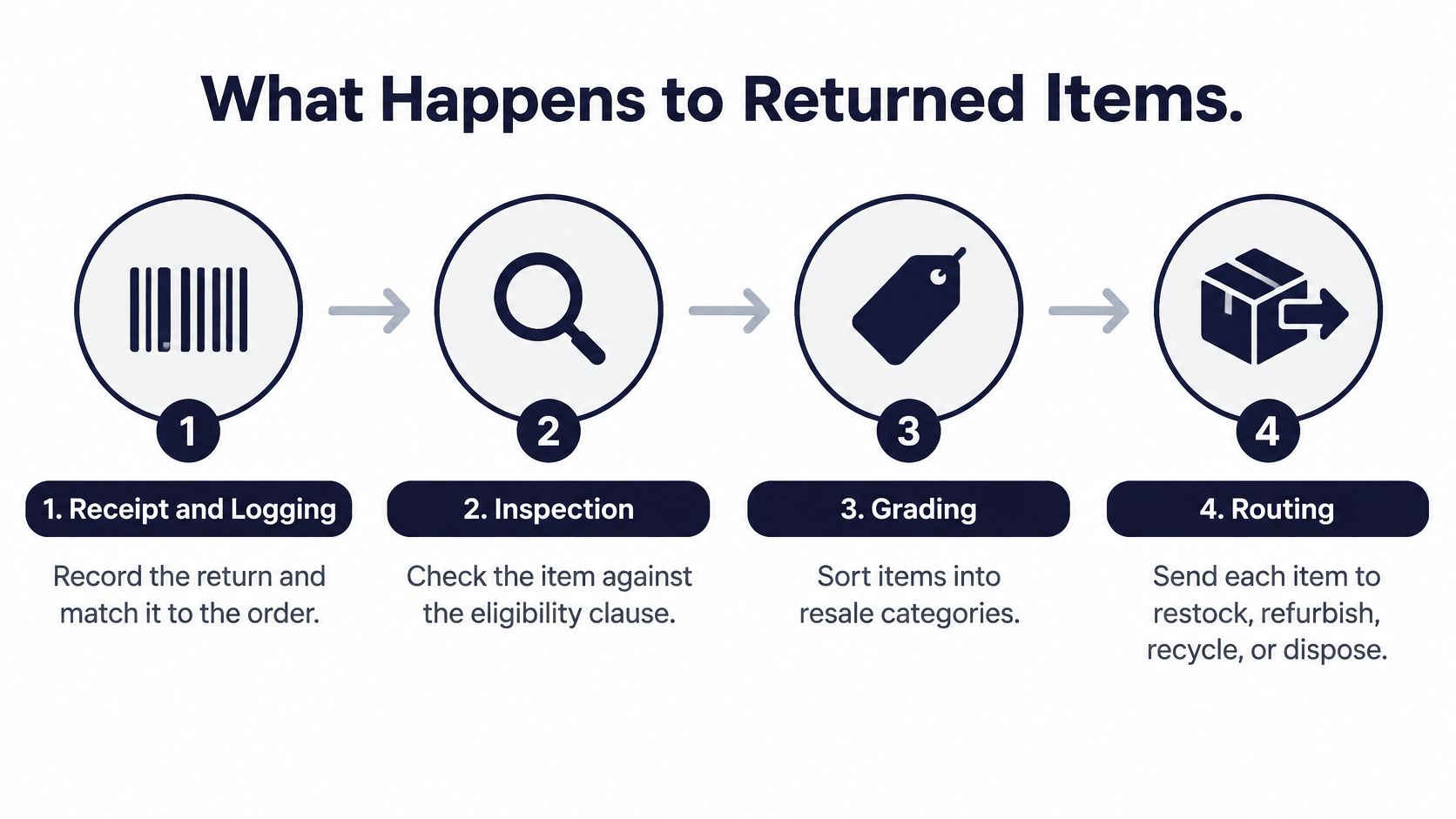
Paste and adapt: "Returned items are inspected within [number] working days. Items in resaleable condition return to stock, while others are refurbished, donated or recycled."
Describe only routes you use. A donation promise you don't keep costs more trust than leaving the sentence out.
Abuse Controls, Fraud Checks and Appeals
"We may refuse abuse" is not a clause. It doesn't tell a legitimate customer why a return was stopped, and it doesn't tell an agent what to refuse. The temptation is understandable given the volume: Chain Store Age, citing NRF estimates, reported that retailers expected 15.8% of sales to be returned in 2025, about $849.9 billion, with 9% of returns classified as fraudulent.
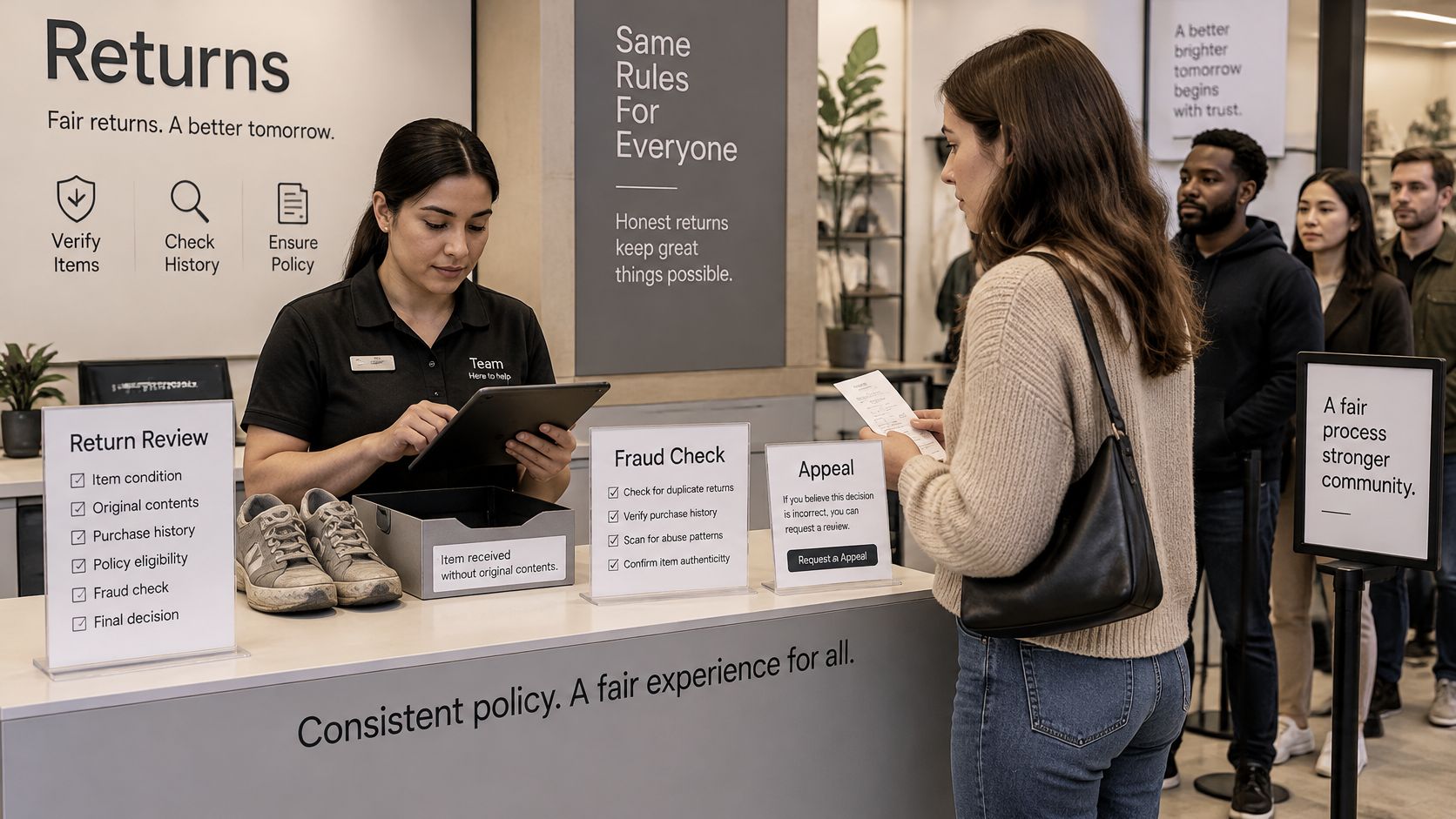
Define abuse as conduct you can point at: repeated returns of worn items, a parcel with no product in it, serial returns above a threshold you publish, or a non-delivery claim that tracking contradicts. Each pattern needs a named response. A wrong item sent back, or a missing accessory, is a mistake rather than a scheme, so say you'll ask for the right goods or apply the partial-refund formula instead of closing the account.
Treat the restriction clause itself as a promise with steps. If you act against a customer whose conduct crosses no published limit, tell them in writing and give them at least 30 days to discuss or adjust before any restriction applies. That sequence is what separates a policy from a punishment.
Evidence and the messy cases
Every fraud clause should answer three questions: who decides, what they read, and when the money moves. The evidence list is usually tracking that shows delivery, photos taken at receipt, a weight check and the inspection note. Write down what happens in the four fights that fill the queue: tracking says delivered but the customer has nothing, the carton is missing, the wrong SKU came back, or someone wants the refund before inspection. State whether a score or a person made the call, and which fields were read.
Tighter controls catch real loss. They also hit fashion, where size drives a large share of honest returns, so publish the threshold rather than letting a second exchange look like a fraud ring. Unexplained refusals feed payment disputes, which is why the appeal text should sit next to your notes on how to reduce chargebacks.
Paste and adapt: "If we decline a return, we will tell you why in writing, and you may ask us to review the decision within [number] days."
Why was my return flagged? Because it matched a stated pattern, such as wear, an empty parcel, or a threshold, not because an agent disliked the order.
Can I appeal an automated decision? Yes. You write back inside the published period, and a person reviews the same evidence plus anything you add.
What evidence covers a lost, damaged or incorrect item? The tracking status, photos, and the order number. For non-delivery, say what you do when the scan and the customer disagree.
Link, Check and Publish Your Return Policy
Five pages have to use the same words, or the return page will lose every argument.
- Shipping policy. Dispatch dates and delay notices. They start any refund clock for goods you haven't shipped.
- Terms and conditions. Governing law, liability limits, and statutory rights your return page can't delete.
- Privacy notice. How long you keep order numbers, tracking numbers and damage photos, and who can see them.
- Warranty page. Defect claims, kept separate from change of mind.
- Complaints procedure. Where a refused return goes after the appeal window.
Define day, delivery and receipt once, in the terms, and reuse those definitions. Link the policy from checkout, the order confirmation, and the account area. A policy that only lives in the footer will be quoted by nobody.
Publishing checklist
- Fill the ten rows with values your warehouse and your payment provider can hit.
- Match the timelines on the shipping page and the refund page.
- Have a lawyer check each market. You are responsible for a policy that complies where you sell. We don't review or approve the refund and returns policies merchants publish.
- Run one return from request to refund, including a guest order.
- Publish a numbered, dated version so staff can say which text applied.
- Reread it when a carrier, a market or a statute changes.
Customers, including guests, can request a return online and pick a reason you defined, so those reasons can mirror the clause list. That tool doesn't write the policy. You still choose the window and the cost model, and you still stand behind the sentences.
Decide those two commitments before you paste the template. A number you haven't agreed with finance and the warehouse is the next dispute, not a finished sample return policy.
CIQRA Commerce gives stores a single place to run catalogues, checkout and customer-started returns, including guest requests tied to reasons you define. Pair that workflow with a sample return policy your lawyer has checked, so the page, the label and the refund all describe the same promise. Visit CIQRA to see how Sites and Commerce fit the operation you already have.